Self-organization of Artificial Molecules Opens
A New World of Chemistry
by Toyoki Kunitake@@@@@@@@@@@@@@@
Professor of Graduate School, Division of Engineering
@@It has been a long-standing dream of materials scientists to artificially manufacture organized molecular assemblies of given sizes and shapes. A living organism can produce spontaneously complex giant molecules such as proteins and nucleic acids as fundamental functional units of the biological process, which, in turn, lead to supramolecular systems of greater complexity. Therefore, if we can mimic this self-organization process by artificial means, we shall be able to manufacture unprecedented varieties of useful molecules and materials. This is why highly competitive worldwide research is being conducted towards molecular self-organization, molecular recognition and design of nano-sized materials. This research area is also called supramolecular science and covers broad interdisciplinary areas of chemistry, physics, biology and materials engineering.
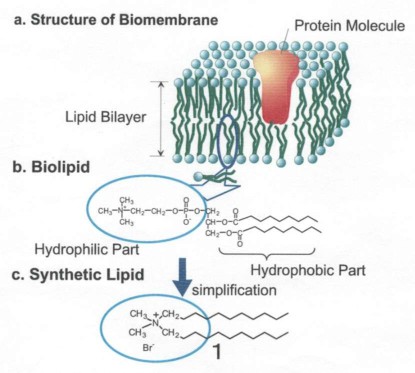
@@Synthetic bilayer membranes are a typical example of this approach. We found in 1977 that stable molecular bilayers similar to that of the biological membrane were produced spontaneously from simple synthetic soap-like molecules. This process was observed for many artificial compounds in subsequent studies and is now established as a general rule of molecular self-organization.
@@Molecular recognition is another concept that characterizes supramolecular chemistry. Highly organized molecular assembly is made possible only through precise recognition among component molecules. It is fortunate that there are a collection of world-renowned research groups in organized molecular systems and molecular recognition at Kyushu University.
@@For this reason, the Ministry of Education selected in 1996 a research consortium at Kyushu University as one of the Center-of-Excellence programs. This 5-year program (currently headed by Prof. Shinkai of Engineering Faculty) is being operated with an annual budget of 200-500 million yen for facilities and chemicals, and includes seven research groups. The university additionally built a research unit of 1000 square meters to accommodate the newly acquired instruments and work benches.
@@Through the midpoint of the program, a variety of new findings have been reported from this group. The design of molecule magnets, molecular organization on surfaces, novel one-dimensional materials and the formation of molecular patterns are among those accomplishments.
@@Toyoki Kunitake was born in Kurume City, Japan, in 1936. He received his Bachelor's and Master's of Engineering from Kyushu University and his Ph.D. from the University of Pennsylvania (supervisor, C. C. Price). After a one-year stay at the California Institute of Technology as a postdoctoral fellow, he returned to his alma mater as an Associate Professor and later became Professor and Dean of Engineering (one term). His research interests have changed over the years from polymerization mechanisms and bioorganic chemistry (enzyme models), to supramolecular chemistry of synthetic bilayer membranes and interfacial molecular recognition and preparation of ultrathin films. He also served as a leader in several, large scientific projects. He has received major awards from the Society of Polymer Science, Japan, and the Chemical Society of Japan.