Stronger Ties with KOREA
What Kyudai Means to Me
Kim, Yong Taek
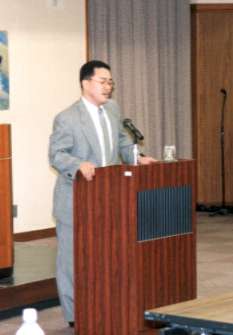
Hello, everyone! My name is Kim, Yong-Taek. I joined in 94-95 JTW(Japan In Today's World) Program as the first exchange student from Yonsei University in Korea to Kyushu University. Now I study at Sophia University in Tokyo where I am majoring in cognitive linguistics.
This article is from my speech at "JTW Program 5th Anniversary Workshop" held in June 19-20, 1999.One day, during the first week of JTW Program, American friends and I decided to have lunch at a traditional Japanese restaurant near Kyushu Univ. But I was getting nervous because I thought "These guys must think I can order in Japanese just because I look like Japanese." I had never eaten out of campus before. I always ate lunch at a cafeteria on the campus because I didn't need to speak Japanese there. Courageously, I entered the restaurant and looked at the menu first. But, oh my God, there were no hiragana on top of the Kanji !! I didn't know what I should do.
At that moment, among the American friends, a young and cute lady asked us what we wanted and ordered for us with fluent Japanese. I was so happy, felt saved by the Heavens. But at the same time I was very ashamed that I couldn't speak Japanese even though an American lady had a good command of Japanese. This was a real shock to me. I had thought that Kanji would be just drawings, not characters to Western people. That was just my prejudice about Western people.
This incident made me concentrate on studying in Japanese classes of JTW and I studied only Japanese more than 4 hours in the main library everyday for about 3 months. An American friend who belonged to kendo-bu told me that I belonged to toshokan-bu, which means a library club. Thanks to excellent Japanese classes and 3 months' study in the library, I was able to experience a sort of miracle like this.
We biked to school from our dormitory. One day, I had a flat tire. So I went to an elderly man who volunteered to take care of all bikes at the International Students' House. While he was repairing it, he kept on saying something which sounded like Japanese but I couldn't understand a single sentence. So I just kept on smiling for about 10 minutes. It was the first experience in my life to communicate by smiling for 10 minutes. After the 10 minutes, I made up a rationalization that "It's not because my Japanese is poor but because he is speaking Kyushu dialect, 'hakataben', not standard Japanese."
About 3 months after, I had another flat tire. I had to ask him again. But this time, to my surprise, I could understand most of what he said. This was a miracle to me. Funny thing was it was he not me who was surprised much more at my improved Japanese. And you know what? He was speaking not 'hakataben' but standard Japanese.
Japanese hold up their bowls and use chopsticks while Koreans use spoons to eat rice or soup and chopsticks for side dishes without holding bowls. I asked some of my Japanese friends, "Why don't you use spoons? If you use spoons, you don't need to hold up bowls." One of them told me, "We use spoons when we are children, but it looks childish if adults do." Another friend said "We call eating without holding bowls a dog's way of eating." On the contrary, most Koreans think holding up bowls is not good manners and some of them even think only beggars do that.
Japan is blessed with abundant straight trees, so wooden culture, like wooden chopsticks, bowls, etc., is developed, while Korea has a long history of using metal goods, such as metal chopsticks, spoons, bowls, and so on. What if Koreans hold up metal bowls with hot rice or soup? We will burn on our hands, and it is much more efficient to use spoons than chopsticks when you eat without holding bowls. I guess these are some of the reasons why Japanese hold up their bowls while Koreans don't.
When we think about other culture, the most dangerous thing is to evaluate it on the base of our own culture, which only can result in misunderstanding. Before we criticize other cultures, we need to take off the glasses of 'prejudice' and try to find out what made this cultural difference. How can we take off the glass? The best way is to live in other countries and communicate with people there. It is very hard for a child to realize what his house has or does not have until he visits another house. Communicating with foreigners in a foreign language can open a new horizon to us and broaden our outlook.
Although I haven't had enough time to prepare, I said 'Yes' when I was asked to make a speech as one of the alumni of JTW Program. You know why? I could find the answer in 'The Moon and Sixpence' by W. Somerset Maugham.
'Sometimes a man hits upon a place to which he mysteriously feels that he belongs. Here is the home he sought, and he will settle amid scenes that he has never seen before, among men he has never known, as though they were familiar to him from his birth. Here at last he finds rest.'
--- That is Fukuoka for me.