Professeor of Organic Chemistry
University of Hannover, Germany
今回は,協定校であるドイツのハノーバー大学から機能物質科学研究所に来られていたButenschön 先生による訪問記です。日本は,先生と奥様にとって特別の国であるということですが,さてその訳は?
Japan was not completely new for my wife and for me. In fact, my wife and I met for
the first time in Japan, when as early as 1972 and for really lucky circumstances, we
participated in the German-Japanese youth exchange program. At that time we travelled
through Japan in a group of 20 young people for four weeks, visiting schools and
companies, looking into universities and living in Japanese families for some days, and
this unique trip of our youth had some consequences: We married, and today we have four
daughters. You will understand, that Japan has a huge emotional meaning to my family and
me!
When I arrived at Fukuoka in June I immediately experienced the warm hospitality of
many people I was supposed to work with in the months to come. In particular, Professor
Dr. Shuntaro Mataka and Associate Professor Dr. Thies Thiemann were of invaluable help
in organizing everything which was needed at the beginning, starting from buying household
goods to getting settled in the nice guest house at Maidashi campus and to explain how
to get from there to Kasuga campus by train not being able to read Japanese timetables
of JR.
In my room at the Institute of Advanced Material Study I found very good working
conditions. Far away from Hannover I was not interrupted by the usual administrative
duties or phone calls, but concentrated on certain projects. One of these was to finish
writing a rather big review article on some organometallic chemistry. I gave an
introductory course on organometallic chemistry and was very much pleased about the
interest this enjoyed among the graduate students of the institute. I had the
opportunity to visit a number of Japanese universities giving lectures about our
chemistry and learning a lot about the recent developments of organometallic chemistry
in Japan, which clearly belongs to a small group of leading countries in this field.
Here in Fukuoka I enjoyed fruitful discussions with many people. There are many common
interests in the field I work in, which is organometallic chemistry, specifically the
area of chromium complexes and the organic chemistry taking place at their ligands.
Of course, these visits were interesting and most enjoyable not only to discuss
science, but also, because Japan has a spectacular countryside with many scenic spots.
I particularly like the contrast between mountains and the sea, and Japan has a lot of
this! In addition to this, and a point of special importance to me, Japan has a very
interesting, tasty and unique cuisine. Food like sushi, sashimi, tempura and much, much
more can be found only in Japan. And it is not only the taste and the kind of food which
attracts, it is also the way by which it is arranged: First, one enjoys with the eye,
then with the tongue.
During the German summer school holidays my family came here from Germany, and
immediately after they arrived here, they also enjoyed Japanese hospitality. As usual,
at the end of July a number of chemistry research groups from Kyushu and southern Honshu
met at Kuju in Oita prefecture for some days to have a joint seminar. We also were there,
and my family was very happy to have been included in all the side activities which, in
addition to scientific discussions, made the seminar a success. In addition to this, we
did some travelling in the southern part of Japan, which was really interesting. You must
know that there are no active volcanoes like Mt. Aso or Mt. Unzen in central Europe.
Especially my daughters (5 to 12 years old) enjoyed wild monkeys in Beppu! And all of us
became friends of the hot Japanese bath, which I regard as the optimum way to completely
relax. These are just a few examples for many wonderful things we saw and enjoyed here.
All this would not have been possible without much help and support, which I received
from Kyushu University in general and Professor Mataka and his research group in
particular. I would therefore like to express my sincere gratitute to everyone who
contributed to the success of these three great months in Fukuoka. It was a pleasure
for me to participate a little bit in the by now 10 years old cooperation agreement
between Kyushu University and the University of Hannover, and I would be most pleased
to welcome professors or students from Kyushu in Hannover, either as short term visitors
or within larger projects. Why not go for a doctor's degree in Hannover?
Today is my last day here at Kyushu University. Tomorrow I will leave Japan and soon
return to my home university in Hannover, Germany. This is the end of a bit more than
three months which I spent as a foreign visiting professor at the Institute of Advanced
Material Study in the research group of Professor Shuntaro Mataka, and these three months
were really a great time for me.
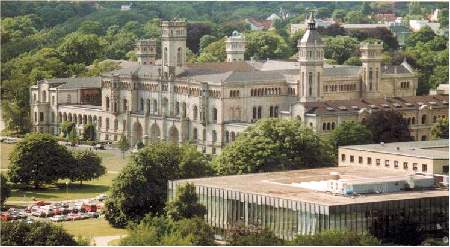
In 1879, the college moved into the Welfenschloβ, the former
royal palace.
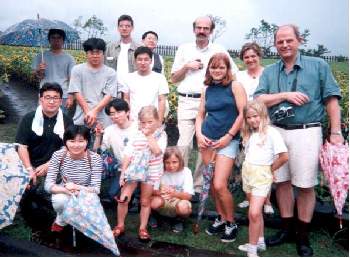
Dr. Butenschön(far right) with his family and friends.