


































研究成果 Research Results
- TOP
- News
- Research Results
- Researchers propose a new model to study developmental dyslexia
Researchers propose a new model to study developmental dyslexia
Researchers suggest that the proposed approach may have implications for personalized educational and clinical interventions for individuals with dyslexiaAssociate Professor Shinri Ohta
Faculty of Humanities
2026.01.08Research ResultsHumanities & Social SciencesLife & Health
Fukuoka, Japan—Dyslexia is a common developmental disorder, affecting around 7% of the global population. It is characterized by difficulties with accurate or fluent reading and spelling, despite average intelligence and adequate schooling. Without appropriate support, these difficulties can lead to secondary consequences, including learning delays, reduced self-esteem, and limited educational and career opportunities, highlighting the societal importance of effective educational and medical support.
Recent neuroimaging studies suggest that developmental dyslexia comprises several subtypes with distinct symptom profiles, each associated with characteristic functional and structural abnormalities in the brain. However, how these regional brain-activity abnormalities lead to specific symptoms remains unclear. Moreover, while research using animal models such as mice or rats is effective in studying many brain disorders, it is not suitable for dyslexia because reading and writing are uniquely human skills.
To address this gap, the authors developed a human model of dyslexia, in which key dyslexia-related features are temporarily and safely induced in neurotypical human volunteers. This approach allows researchers to directly examine how specific patterns of brain activity relate to reading behavior, helping to accelerate the development of more personalized interventions. The study was published in October 2025 in Frontiers in Human Neuroscience.
“We proposed the feasibility of a two-step approach to creating human models of distinct dyslexia subtypes,” explained Daniel Gallagher, a postdoctoral fellow at Kyushu University’s Faculty of Humanities and the paper’s first author. “First, we analyzed neuroimaging datasets from children and adults with and without dyslexia, grouping them by how their brains differ in areas related to reading.”
Using these data, the team identified brain regions that consistently show functional or structural differences in individuals with dyslexia, including areas involved in converting letters to sounds and recognizing written words. These brain regions are then organized into patterns that may correspond to different dyslexia subtypes.
“The second step is to temporarily reproduce these subtype-specific brain patterns in humans,” continued Zian Huang, a graduate student at the Graduate School of Humanities and the paper’s second author. The team used transcranial temporal interference stimulation (tTIS), a gentle, non-invasive brain stimulation technique that delivers weak electrical currents through electrodes placed on the scalp, targeting deeper brain regions in a focused manner. By systematically adjusting electrode placement and stimulation parameters, the researchers designed protocols to modestly reduce activity in specific dyslexia-related brain patterns. This two-step approach enables the design of safe experiments that transiently “mimic” dyslexia-like difficulties in neurotypical adults, allowing direct investigation of underlying mechanisms and potential therapeutic strategies.
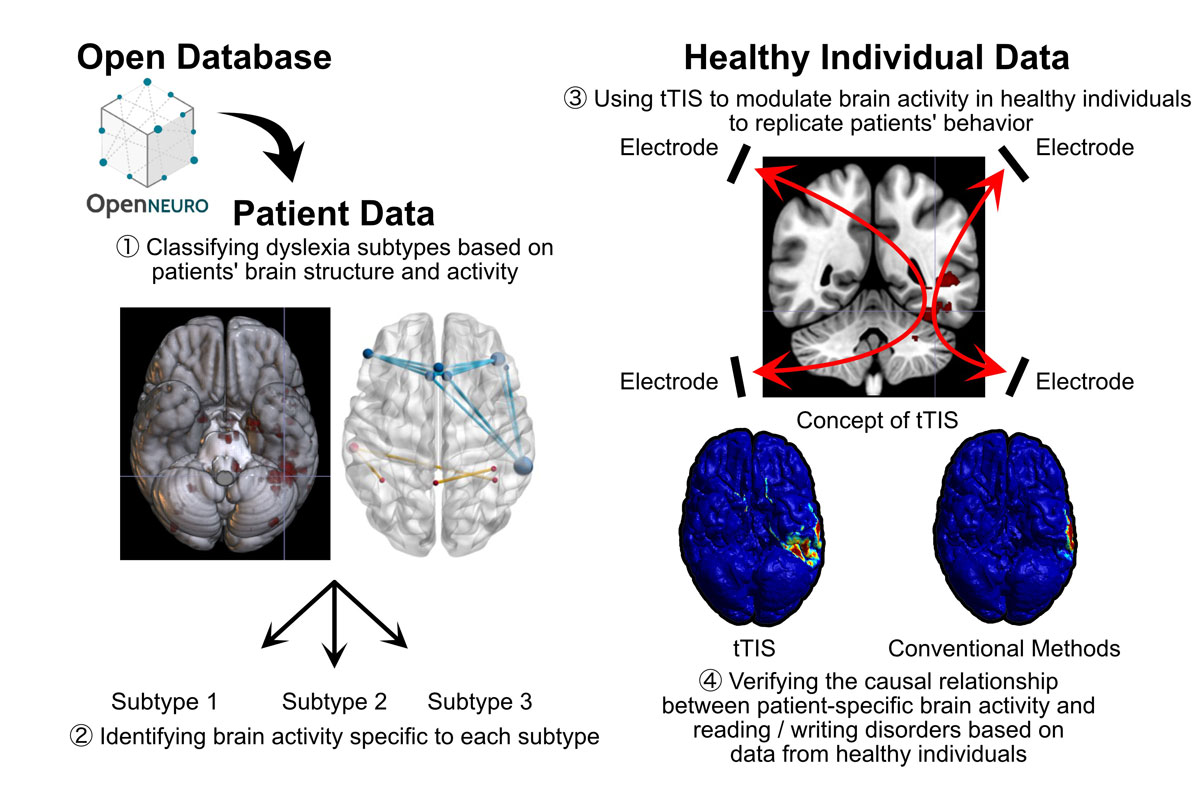
Using patient data from a public database, researchers at Kyushu University detected brain structures and activities characteristic of developmental dyslexia and classified patients with developmental dyslexia in a data-driven manner. By examining behavioral and cognitive changes induced by transcranial temporal interference stimulation (tTIS) in healthy individuals, which elicits brain activity similar to that observed in patients, they verified brain abnormalities associated with developmental dyslexia. Compared to conventional non-invasive brain stimulation methods, tTIS can stimulate deeper brain regions.
“Although many aspects of this approach—particularly the brain stimulation protocols—still require careful validation in experimental settings, this study proposes a novel human disease model for developmental dyslexia that could transform how the condition is studied and ultimately treated,” said Associate Professor Shinri Ohta from Kyushu University’s Faculty of Humanities.
Clearer brain-based subtypes could help parents and educators understand why a child struggles in a particular way and what support works best. Researchers aim for this work to aid the development of more personalized educational and clinical support. Moving beyond one-size-fits-all approaches may allow earlier, better-matched interventions, helping to reduce academic difficulties and associated mental health challenges. Ultimately, this could ease the long-term burden on individuals and society.
###
For more information about this research, see "Modeling dyslexia in neurotypical adults by combining neuroimaging and neuromodulation techniques: a hypothesis paper," Daniel Gallagher, Zian Huang, Shinri Ohta, Frontiers in Human Neuroscience,
https://doi.org/10.3389/fnhum.2025.1651332
Research-related inquiries
Shinri Ohta, Associate Professor
Faculty of Humanities
Contact information can also be found in the full release.
- TOP
- News
- Research Results
- Researchers propose a new model to study developmental dyslexia