


































研究成果 Research Results
- TOP
- News
- Research Results
- Research shows medieval images can create immersive experiences beyond sight
Research shows medieval images can create immersive experiences beyond sight
A researcher from Kyushu University integrates neuroscience with the “sound milieu” framework to argue that medieval visual culture engaged viewers in multisensory ways.Associate Professor Britton Elliott Brooks
Faculty of Languages and Cultures
2026.04.30Research ResultsHumanities & Social Sciences
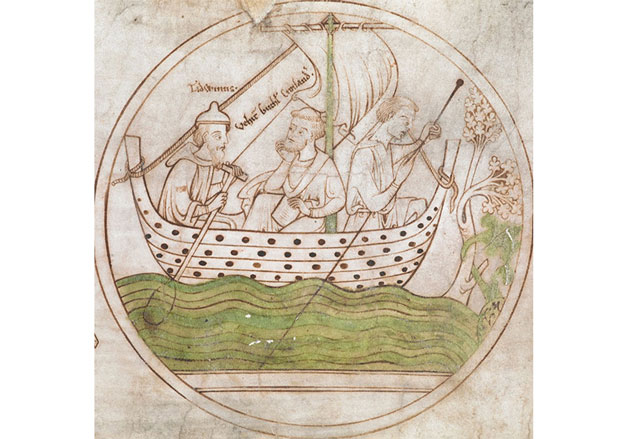
Roundel four of the Harley Roll, a 12th–13th century English scroll depicting the life of Saint Guthlac in. It shows Saint Guthlac’s boat journey to Crowland. Using curved waves and billowing sails, the scene evokes the sensory experience of travel. Brooks integrates neuroscience with the “sound milieu” framework to argue that medieval visual culture engaged viewers in multisensory ways.
Fukuoka, Japan—In cathedrals, such as Canterbury Cathedral in England, colorful stained glass and illustrated hagiographies tell the stories of saints through vivid visual narratives, inviting viewers into richly detailed scenes. Sometimes, this experience extends beyond sight, creating a deeper sense of immersion.
A new study published in Religions in December 2025 explores the role of sound in medieval English imagery. Employing a combined approach that integrates neurobiology and the framework of the “sound milieu,” the researcher argues that early medieval images were never “silent.” Instead, they could evoke imagined acoustic environments, allowing immersive, multisensory interaction with the scene.
“Unlike today, books in the medieval period were extremely expensive, and many people could not read Latin, the primary language of the church,” says Britton Elliott Brooks, Associate Professor at Kyushu University’s Faculty of Languages and Cultures, who conducted the study. “For ordinary people such as farmers or fishermen, sound rather than text was the primary way they engaged with spiritual life.”
Brooks' current research explores the relationship between early medieval people and the North Sea, seeking to reconstruct a more fully sensory Middle Ages. In the absence of recording technologies, no direct archives preserve the sounds that once shaped everyday medieval life. Therefore, he listens for them in the textual and visual materials of that age. This time, he turned his ears towards the Harley Roll, a medieval English scroll produced in the 12th–13th centuries depicting the life of Saint Guthlac in 18 roundels.
Sound in a medieval scroll
Saint Guthlac, an early medieval English saint, has attracted growing scholarly attention in recent years. Once a warrior, he came to reflect on the fleeting nature of worldly glory and wealth, withdrew into isolation, and devoted himself to God. His hermitage later developed into Crowland Abbey, located about 130 kilometers north of present-day London.
By comparing the scroll with an earlier hagiography on which it draws heavily, Brooks shows that some sonic details in the images are chosen deliberately, while others emerge more implicitly through visual representation.
He highlights scenes such as Guthlac’s boat journey to Crowland and the construction of his hermitage. While the original text mentions the journey only briefly, the scroll elaborates it visually, using curved waves and billowing sails to evoke the sensory experience of travel—the whip of wind, the clack of oars, and the hum of ropes. In the construction scene, although the earlier hagiography notes that Guthlac built only a “small dwelling,” the scroll depicts him working alongside laborers, hammering and stacking stone, recalling the rhythmic sounds of building. Archaeological evidence further suggests that these details were updated to reflect a 12th-century context.
“This updating effectively translates the saint’s life into a more contemporary visual language. All these elements would be very familiar, contemporary artifacts for people at the time, and together they create extremely recognizable sonic occurrences,” Brooks says.
How images “sound” in the mind
To explain how images can evoke sound, Brooks draws on interdisciplinary insights. He draws from the concept of the “sound milieu,” which describes sound as an in-between, immersive space shaped by its sources, its listeners, and the vibrations that connect them. Neuroscience further illuminates the interactions between viewers and aural images. Within the framework of predictive processing, the brain generates predictions about sensory input based on past experiences. When seeing an image closely associated with a particular sound, such as a hammer striking or a sail billowing in the wind, the auditory cortex can be slightly activated, creating a mental impression of sound even in silence.
The scenes in the Harley Roll also echo the lived experiences of pilgrims. Many would have traveled by water to reach such sites, and religious places at the time were often characterized by ongoing building and rebuilding. The imagery resonates with what viewers actually heard around them, linking the saint’s story to their own experience.
“When people came to a religious center, they were usually hoping for a miracle, often seeking healing,” Brooks explains. Such multisensory settings, he adds, “provided rich avenues for the faithful to seek contact with the saints.”
Localized sounds and multimodal experience
Beyond natural and architectural sounds, Brooks examines non-human sounds made by animals. In one scene, demons with animal heads surround Guthlac's hermitage, mouths open, gesturing toward him without making contact.
“Imagine sitting alone in the dark and hearing a beast roaring outside,” Brooks says. “It would be terrifying. The interesting thing is that the attack is not physical, but purely sonic.”
In Christian tradition, creatures such as ravens and wolves were often depicted as demonic forces attempting to disrupt saints’ devotion. Rather than physical violence, the illustrator emphasizes harsh, frightening sounds to convey spiritual attack. The choice of animals is also significant: exotic creatures such as apes create an uncanny effect, while other local ones, such as birds of prey, draw on sounds English pilgrims would have heard, making them easier to imagine vividly.
Brooks continues to examine how literary representations of sound appear in material culture and expects to extend this multimodal approach beyond hagiography, with growing attention to local context.
When early medieval people encountered an image, Brooks argues, they did so multimodally, experiencing it not just through sight or sound, but through all their senses at once. That embodied mode of perception shaped how they interpreted what they saw.
“I grew up in Hawaiʻi, where the ocean is clear, warm, and sandy, and it is very different from the North Sea,” he explains. “Walking along its muddy, silty shorelines, where your boots sink with every step, gives you a completely different tactile sense of the environment. That experience changes how I read the sources.”
###
For more information about this research, see " Material Aurality: Sound Milieu(s) in the Guthlac Roll," Britton Elliott Brooks, Religions 2025, 16(12), 1522; https://doi.org/10.3390/rel16121522
Research-related inquiries
Britton Elliott Brooks, Associate Professor
Faculty of Languages and Cultures
Contact information can also be found in the full release.
- TOP
- News
- Research Results
- Research shows medieval images can create immersive experiences beyond sight