































研究成果 Research Results
- TOP
- News
- Research Results
- Scientists show how baby stars' cradles get their radial shape
Scientists show how baby stars' cradles get their radial shape
New 3D simulations show a dying star's last shockwave can weave a star-forming hub into shapeShingo Nozaki
Graduate School of Science
2026.05.28Research ResultsPhysics & Chemistry
Video 1. Simulation of a Hub-Filament System taking shape
This video shows a 3D simulation of how a hub-filament system forms. After a fast interstellar shockwave passes through a gas cloud, multiple elongated filaments gradually develop, radiating inward toward a dense central hub. The left panel shows a side view of the direction the interstellar shockwave is traveling; the right panel shows the same cloud as seen head-on, from the direction the shockwave is coming from. The number in the upper left shows the time since the simulation started. Note that the right panel uses a different density range than the left to make the denser gas easier to see.
Fukuoka, Japan—The universe is full of fascinating structures, and some of the most striking take shape inside the giant clouds where stars are born. There, streams of gas appear to converge from all directions toward a dense central hub, like spokes meeting at the center of a wheel.
Now, researchers from Kyushu University and Nagoya University have used 3D computer simulations to reveal the physics behind these elegant structures. The study was published in March 2026 in The Astrophysical Journal Letters.
“Stars are born inside molecular clouds—vast, cold clouds of gas that drift through space,” says Shingo Nozaki, a doctoral student at Kyushu University's Graduate School of Sciences, and a Research Fellow of the Japan Society for the Promotion of Science (JSPS). “But they only form in the coldest and densest parts of those stellar nurseries, where gas can collapse under its own gravity. In some of these star-forming regions, gas is organized into characteristic hub-and-spoke patterns known as Hub-Filament Systems (HFS).”
How this radial pattern forms, however, has long remained unclear. At a workshop at Kyushu University last summer, Nozaki and Shu-ichiro Inutsuka of Nagoya University began exploring one possible explanation: what happens when an external shock hits a gas cloud with a pinched magnetic shape?
Using ATERUI III, an astronomy-dedicated supercomputer operated by the National Astronomical Observatory of Japan, they conducted a 3D magnetohydrodynamic simulation, a computational method that models how gas and magnetic fields evolve together over time.
As a rough analogy, Nozaki pictures the initial molecular cloud as a dorayaki—a Japanese pancake that's thick in the middle and thin at the edges. A vertical magnetic field runs through the cloud, while gravity pulls the field inward at the center, bending it into an hourglass shape. The team then introduced a cosmic disturbance into the cloud, mimicking the kind of disturbance triggered by a supernova remnant or by expanding gas around massive stars.
The results show several elongated structures that develop toward a dense central region, closely resembling the observed HFS. As the magnetic field lines curve inward, the shock wave strikes different parts of the cloud at different angles, creating what physicists call oblique shocks. These shocks strengthen parts of the magnetic field, forming invisible channels that guide compressed gas into long, narrow filaments converging toward the center.
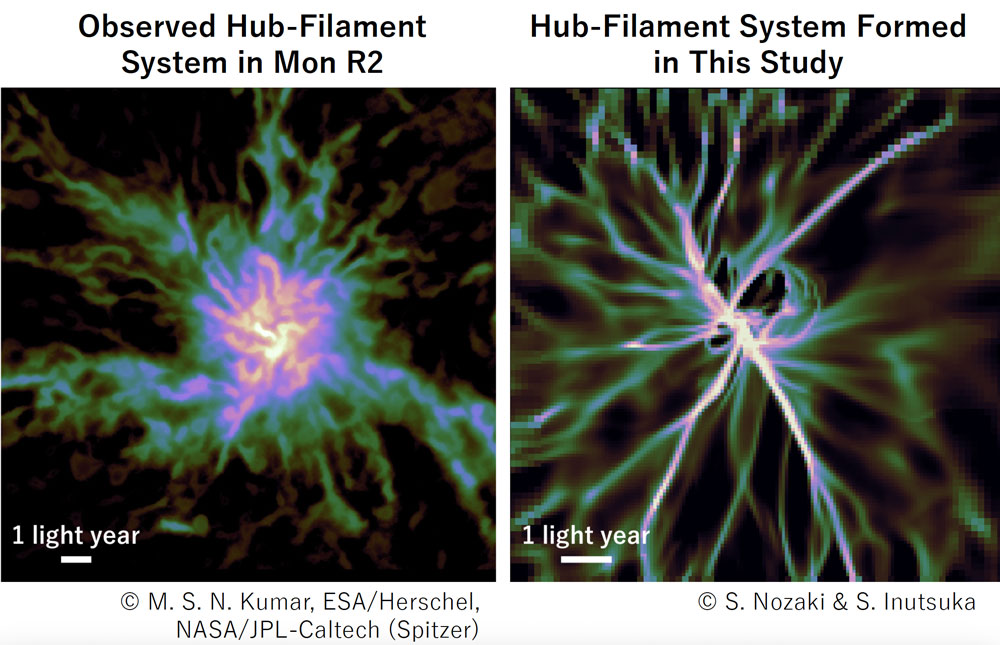
The left panel shows a hub-filament system observed in an actual star-forming region; the right shows the structure produced by this study's 3D simulation. Both show multiple elongated filaments of gas radiating toward a dense central hub. The study shows that this characteristic pattern can emerge when a fast interstellar shockwave strikes a molecular cloud with a curved magnetic field.
The simulation also revealed that gas does not flow uniformly into the hub. Dense gas within the filaments moves steadily inward, accelerating as it approaches the center, while the low-density gas between filaments stays mostly still. This indicates that the main carriers of mass to the central region are the shock-produced dense filaments, not the cloud as a whole, offering insights into why star formation efficiency remains limited to a few percent.
The team notes that this study focused on a geometrically regular type of HFS, while many observed systems are more asymmetric and complex. Next, they plan to systematically vary the shock direction and strength, the cloud’s density structure, and the magnetic field geometry. This will help them connect different cloud environments to the formation of various massive stars and clusters, and more broadly, to understand how star formation proceeds across galaxies.
“There are two main sources of these shock waves: radiation-driven ‘bubbles’ from newly formed massive stars, and expanding supernova remnants when a massive star reaches the end of its life,” adds Nozaki. “There is something almost like a cycle of life in this. What a star leaves behind can go on to shape the next cradle of stars.”
###
For more information about this research, see " An Origin of Radially Aligned Filaments in Hub-filament Systems," Shingo Nozaki and Shu-ichiro Inutsuka, The Astrophysical Journal Letters, https://doi.org/10.3847/2041-8213/ae4c84
Research-related inquiries
Masahiro Machida, Professor
Faculty of Science
Contact information can also be found in the full release.
- TOP
- News
- Research Results
- Scientists show how baby stars' cradles get their radial shape