


































研究成果 Research Results
- TOP
- News
- Research Results
- Why emus can't fly: A 'time switch' in bird embryos holds the answer
Why emus can't fly: A 'time switch' in bird embryos holds the answer
A study from Kyushu University reveals how the timing of a key developmental signal shapes differences in bird breastbone formation and flight ability, deepening understanding of skeletal evolutionLecturer Yuji Atsuta
Faculty of Science
2026.05.14Research ResultsLife & Health
Fukuoka, Japan—Why can eagles soar through the skies while emus are bound to the earth? One secret lies in a skeletal structure called the keel, a blade-like ridge on the breastbone that anchors the flight muscles needed for powered flight. Flying birds have a prominent one, whereas in flightless birds, the keel never fully forms.
In a paper published on April 29, 2026 in Nature Communications, researchers from Kyushu University identified the molecular mechanism behind keel formation. It turns out to be less about which genes a bird carries than about a developmental “time switch.”
“Birds have evolved many clever designs for flight,” says Seung June Kwon, a graduate student at Kyushu University's Graduate School of Systems Life Sciences, and the study’s first author. “People see the wings, but the hidden bones are just as important.”
The team first took a bird’s eye view of breastbone formation across embryonic development in chickens and emus. Chickens are clumsy fliers but retain the skeleton of a flying bird. Emus, large flightless birds from Australia, are ideal for developmental studies thanks to their well-mapped embryonic stages.
Despite different adult forms, researchers found that the early development looked nearly identical. In both species, sternal progenitor cells—the immature cells that would eventually form the breastbone—formed on the left and right sides of the embryo and later merged at the center at roughly the same developmental stage.
The paths diverge at stage 34, about one-third of the way from fertilization to “peep peep.” In chickens, progenitor cells continue to proliferate and form the keel. In emus, they soon mature into cartilage and stop growing.
Gene expression analysis revealed that keel formation is controlled by a molecular “time switch” called Transforming Growth Factor beta (TGF-β), a signaling pathway that regulates cell growth and division. When TGF-β stays active, immature breastbone cells keep dividing. Once it switches off, growth slows.
In both species, TGF-β remains active until stage 34. In emus, it shuts off there, but in chickens, it continues for about two more developmental stages, through stage 36, giving the cells an extended work shift to keep dividing and push the keel downward.
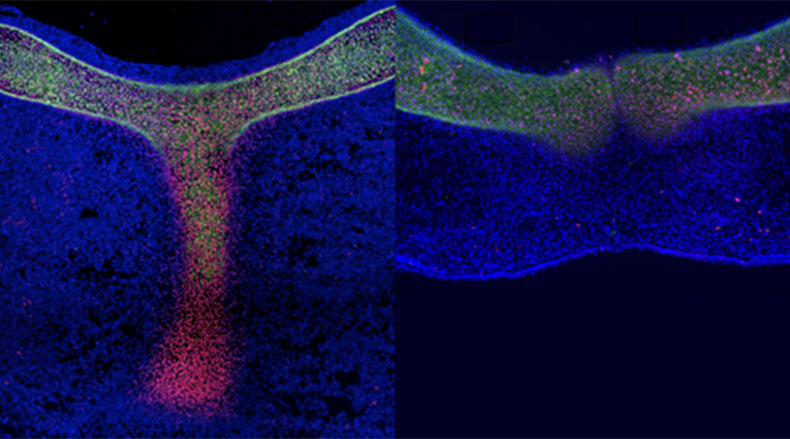
Researchers at Kyushu University found that in both chickens and emus, TGF-β remains active until stage 34. In emus, it shuts off there, but in chickens, it continues for about two more days, through stage 36, giving the cells an extended work shift to keep dividing and push the keel downward.
“What we are seeing here is heterochrony, where a small shift in developmental timing leads to a major anatomical change,” explains Yuji Atsuta, Lecturer at Kyushu University's Faculty of Science, and the corresponding author of the study. “Chickens and emus shared a common ancestor around 100 million years ago, yet their different breastbones come down to two developmental stages in one signaling pathway. It's a very small difference, but it determines the presence or absence of the keel, and ultimately whether a bird can fly.”
The findings excite not only birders curious about skeletal evolution but also researchers in human medicine. Pectus excavatum, a common congenital chest deformity known as sunken chest, may arise from overactive proliferation of the same sternal progenitor cells, and understanding TGF‑β regulation could offer new insights into this condition.
Next, the team is spreading its wings by investigating the enhancer sequences in the genome that control TGF-β duration, hoping to uncover how DNA changes shape the evolution of flight.
“I've had Korean samgye-tang countless times without noticing the keel,” Kwon laughs. “It's exciting to understand how this tiny thing determines whether a bird can defy gravity.”
“Skeletal diversity underlies how animals move and live, so understanding what shapes it matters well beyond birds,” adds Atsuta. “If you've ever had yagen-nankotsu at a Japanese yakitori restaurant, that’s young chicken breast cartilage. Next time you enjoy some, we'd be delighted if you think of our study.”
###
For more information about this research, see “Heterochronic activation of TGF-β signaling drives the diversity of the avian sterna,” Seung June Kwon, Zhaonan Zou, Mizuki Honda, Shiro Egawa, Shinya Oki & Yuji Atsuta, Nature Communications, https://doi.org/10.1038/s41467-026-72602-6
Research-related inquiries
Yuji Atsuta, Lecturer
Faculty of Science
Contact information can also be found in the full release.
- TOP
- News
- Research Results
- Why emus can't fly: A 'time switch' in bird embryos holds the answer