


































研究成果 Research Results
- TOP
- News
- Research Results
- Favorable lifestyle and health linked to lower dementia risk even in people with a genetic risk factor
Favorable lifestyle and health linked to lower dementia risk even in people with a genetic risk factor
A large Japanese study suggests that favorable lifestyle and health conditions are linked to lower dementia risk in people with no or one APOE ε4 allele, while those with two alleles may require different preventive or therapeutic approachesProfessor Toshiharu Ninomiya
Faculty of Medical Sciences
2026.06.05Research ResultsLife & Health
Fukuoka, Japan—With dementia cases expected to nearly triple worldwide by 2050, researchers are increasingly focused on identifying ways to prevent or delay the disease. While lifestyle and health-related factors, such as blood pressure control and physical activity, influence dementia risk, genetics also play a major role. Currently, it is unclear if maintaining a favorable lifestyle reduces dementia risk equally across different genetic backgrounds.
A new study led by Kyushu University and RIKEN, published on May 21 in Alzheimer’s & Dementia: Diagnosis, Assessment & Disease Monitoring, examines whether favorable modifiable risk factors (mRF)—behaviors or conditions that people can change or control—can lower dementia risk even among individuals with high genetic susceptibility.
To explore this, the researchers analyzed data from 9,605 community-dwelling Japanese adults aged 65 and older. They determined each participant's APOE ε4 genotypes, a primary genetic risk factor for Alzheimer's disease, and calculated the mRF score based on lifestyle and health-related factors. This allowed the team to evaluate how genetic predisposition and lifestyle choices jointly interact to influence dementia risk.
The results showed that dementia risk rose progressively with the number of APOE ε4 alleles. Since humans inherit one allele of each gene from each parent, a person can carry zero, one, or two APOE ε4 alleles. Individuals carrying two alleles, known as homozygotes, had over 10-fold higher dementia risk than noncarriers.
Notably, among individuals with one or no APOE ε4 alleles, maintaining a healthier profile with lower mRF scores was linked to a significantly lower risk of dementia. In contrast, among individuals with two APOE ε4 alleles, dementia risk did not differ significantly between those with lower and higher mRF scores.
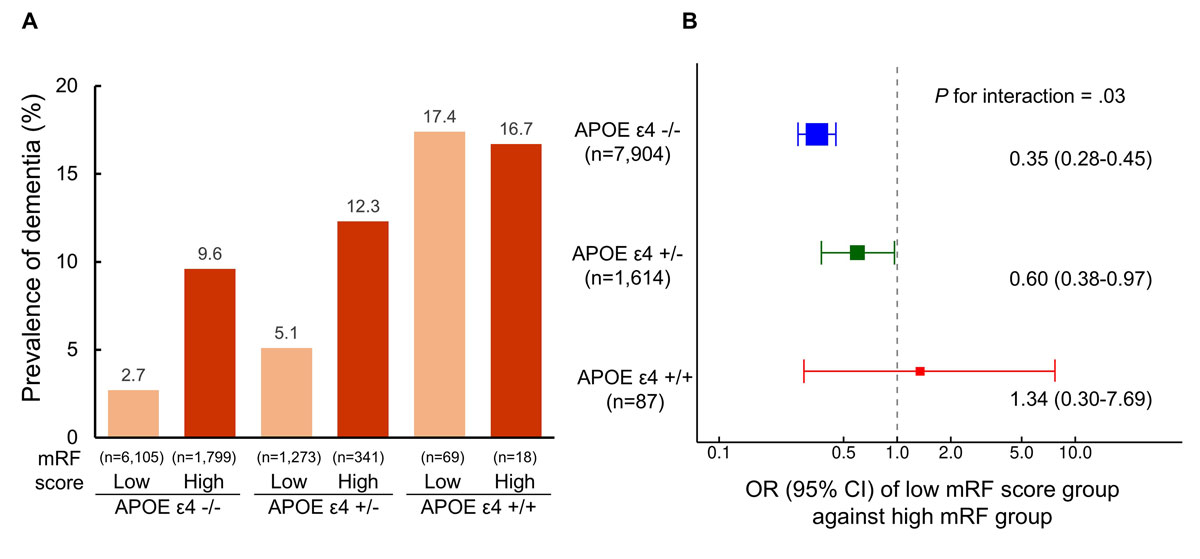
(A) Participants with low mRF scores had a lower crude prevalence of dementia than those with high mRF scores among those with no or one copy of the APOE ε4 variant. Those with two copies showed little difference.
Brain MRI scans supported these findings. Among those with one or no alleles of the gene, lower mRF scores were associated with less brain atrophy and fewer white matter lesions—areas of damaged tissue in the brain that are linked to cognitive decline and dementia. In contrast, individuals with two alleles of the gene exhibited greater brain atrophy and more extensive tissue damage regardless of their lifestyle profile.
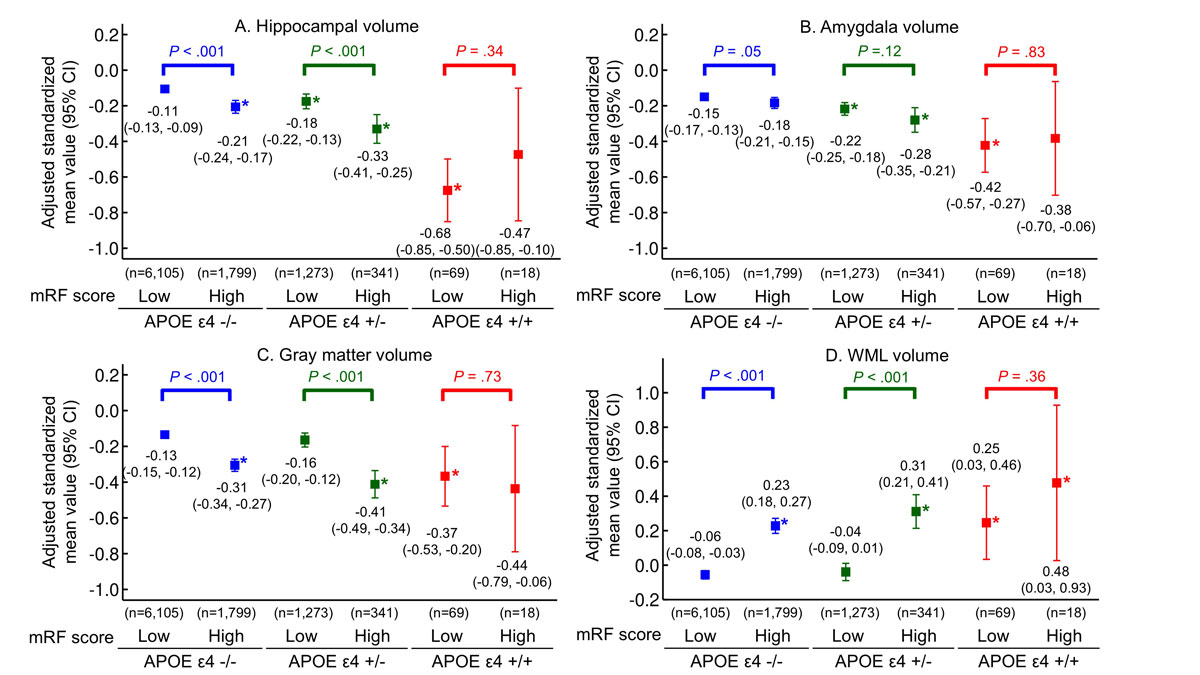
This figure shows the relationship between mRF scores and brain structure in people with different APOE ε4 genotypes. Higher mRF scores were linked to greater brain atrophy and more white matter damage, particularly among APOE ε4 non-carriers and individuals carrying one copy of the ε4 variant.
These findings suggest that maintaining favorable lifestyle and health conditions can effectively mitigate dementia risk, even among individuals carrying a single APOE ε4 allele. This underscores the importance of population-based prevention strategies focused on managing vascular and lifestyle risk factors.
“Among individuals carrying one APOE ε4 allele, as in those carrying no APOE ε4 alleles, favorable management of risk factors may help reduce the risk of dementia,” says Professor Toshiharu Ninomiya from Kyushu University’s Faculty of Medical Sciences, who led the study. “On the other hand, for individuals carrying two APOE ε4 alleles, earlier intervention as well as new preventive or therapeutic approaches beyond lifestyle and health management may warrant consideration.”
###
For more information about this research, see “APOE ε4, modifiable risk factors and dementia in community-based older Japanese adults,” Masaya Kumamoto, Toshiharu Ninomiya, Yoshihiko Furuta, Mao Shibata, Tomoyuki Ohara, Jun Hata, Tetsuro Ago, Yasuyuki Taki, Tatsuya Mikami, Tetsuya Maeda, Kenjiro Ono, Masaru Mimura, Ritsuko Hanajima, Jun-ichi Iga, Minoru Takebayashi, Yukihide Momozawa, on behalf of the Japan Prospective Studies for Aging and Dementia (JPSC-AD) Study Group. Alzheimer's & Dementia: Diagnosis, Assessment & Disease Monitoring, https://doi.org/10.1002/dad2.70371
Research-related inquiries
Toshiharu Ninomiya, Professor
Faculty of Medical Sciences
Contact information can also be found in the full release.
- TOP
- News
- Research Results
- Favorable lifestyle and health linked to lower dementia risk even in people with a genetic risk factor