


































研究成果 Research Results
- TOP
- News
- Research Results
- Capturing the cosmic ‘drift’ before a star is born
Capturing the cosmic ‘drift’ before a star is born
Researchers observe the velocity difference between two molecules in a prestellar core, elucidating the process of early star formationAssociate Professor Doris Arzoumanian
Institute for Advanced Study
2026.07.10Research ResultsPhysics & Chemistry
Fukuoka, Japan—Stars like our Sun are formed from the collapse of stellar objects called prestellar cores, cold and dense concentrations of gas and dust held together by gravity. While many questions remain on the exact mechanisms of star formation, thanks to advanced radio telescopes, researchers have been able to garner new insights into the inner workings of infant stars.
Now, publishing in Astronomy & Astrophysics, researchers from Kyushu University and Max Planck Institute for Extraterrestrial Physics have, for the first time, detected a phenomenon known as ambipolar diffusion occurring in a prestellar core. This phenomenon results in the weakening of the magnetic support of the core, leading to gravitational collapse to form an infant star called a protostar. These new findings provide further insight into the key processes of early star formation, and by extension how stellar systems like ours are created.
“Prestellar cores are fascinating stellar bodies. They are dense and cold, and a source of a lot of complex chemistry. The cold environment allows for molecules to assemble into more complex ones like precursors of prebiotic organic molecules,” explains first author Doris Arzoumanian an Associate Professor at Kyushu University’s Institute for Advanced Study. “One of the questions we are investigating is the role of magnetic fields in star formation. Strong magnetic fields permeate prestellar cores. If that field is too strong, it can delay gravitational collapse and therefore star formation. We wanted to investigate how prestellar cores reduce the strength of their magnetic field.”
Using the Institute for Radio Astronomy in the Millimetre Range (IRAM) 30 m telescope the research team turned their sights to L1544, a prestellar core located in the Taurus molecular cloud, one of the nearest star-forming regions to Earth. In molecular clouds, gas is partially ionized, meaning ions are strongly coupled to magnetic fields, while neutral particles interact with the field indirectly through collisions. Studying these molecules is the key to understanding the state of the core’s magnetic field.
However, because prestellar cores are so cold, the most common molecular tracers freeze onto dust grains, making them invisible. Therefore, the team had to identify a new set of molecules to trace.
“We selected Diazenylium‑d1 (N2D+), an ion, and para‑monodeuterated ammonia (para‑NH2D), a neutral molecule, as our tracers because they are generally located in similar high-density regions within prestellar cores,” explains second author Silvia Spezzano, group leader at the Max Planck Institute for Extraterrestrial Physics. “We therefore collected spectral data of the core and modeled the velocity of the two molecules.”
They found a clear velocity difference between the molecules of about 0.05 km/s, which was interpreted as evidence of ion-neutral drift. As the density of the prestellar core increases, it becomes shielded from radiation, and ionization decreases. This weakens the coupling between the molecules and magnetic fields, and eventually neutral particles decouple and drift inward due to gravity, while ions remain tied to the magnetic field. As the neutral particles fall towards the core center, they speed up while the ions remain coupled to the magnetic field, causing the velocity difference.
“This process is known as ambipolar diffusion. Until now, observing this phenomenon in a prestellar core was a major challenge,” continues Arzoumanian. “As ambipolar diffusion continues, the strength of the magnetic field decreases. Eventually, gravity becomes the primary driving force in the core, resulting in its gravitational collapse into a protostar.”
The team hopes to further confirm their findings by observing additional prestellar cores and obtaining higher-angular resolution observations to better map the velocity drift of ion and neutral molecules.
“These results were possible thanks to an interdisciplinary collaboration of expert observers and theorists in the fields of gas dynamics, astrochemistry, and dust physics,” concludes Arzoumanian. “Understanding star formation addresses a fundamental question about the origin of life in planetary systems and helps us better understand the universe as a whole.”
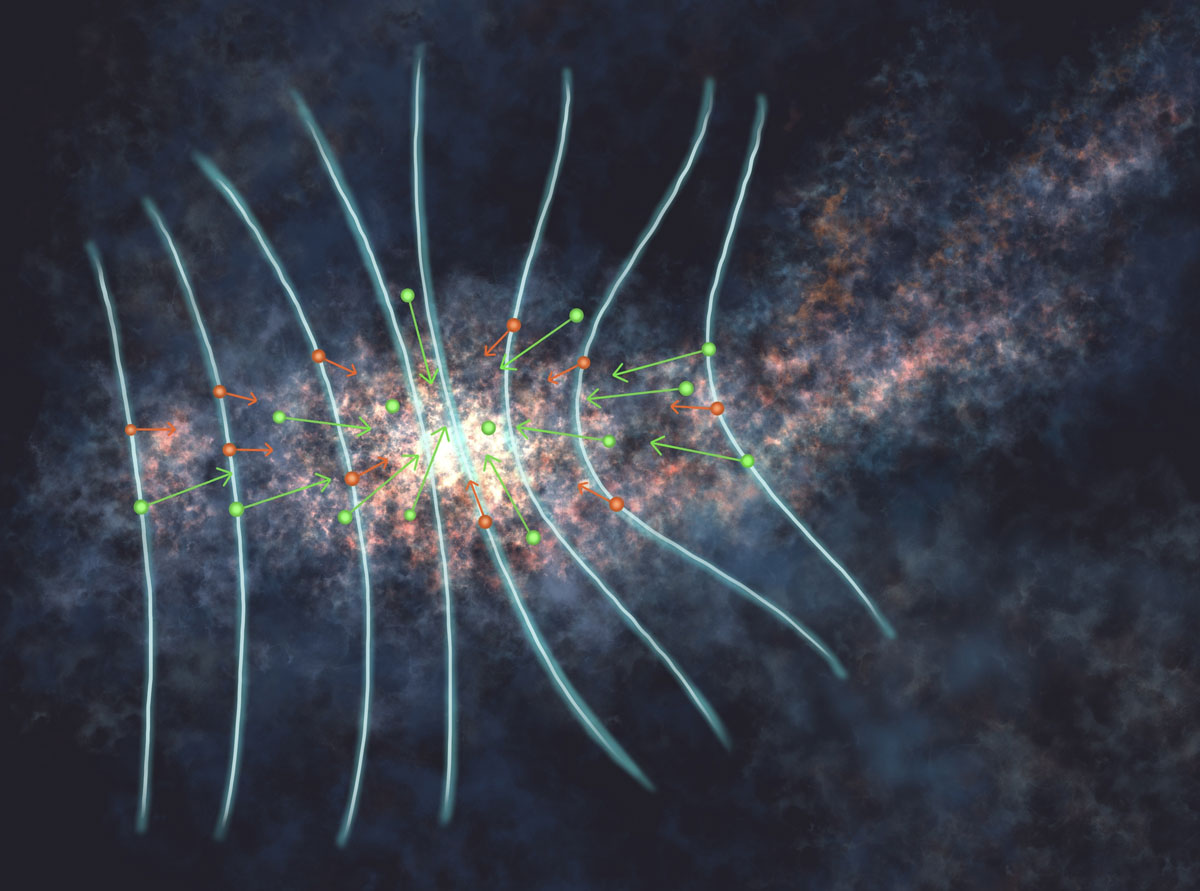
The blue lines represent the magnetic field lines, which are bent due to the gravitational contraction of the core. The red and green dots depict the ion and neutral molecular species, respectively, and the arrows trace their inflow motion towards the core center (the faster they travel the longer the arrows). While in the outer part of the core both the ions and neutrals are attached to the magnetic field lines, within the inner part of the core the neutrals decouple from the magnetic field lines and infall faster compared to the ions, which remain attached to the field lines. This ion-neutral decoupling known as ambipolar diffusion is required for the onset of the gravitational collapse of the prestellar core, which will produce a protostar in its center and ultimately a stellar system similar to our own Solar System.
###
For more information about this research, see "Probing the ion-neutral drift velocity towards the L1544 prestellar core. Detection of ambipolar diffusion using N2D+ and para-NH2D" Doris Arzoumanian, Silvia Spezzano, Tommaso Grassi, Paola Caselli, Yusuke Tsukamoto, Haruka Fukihara, Yoshiaki Misugi, Felipe Alves, Jaime Pineda, Sigurd Jensen, Elena Redaelli, and Alexei Ivlev, Astronomy & Astrophysics, https://www.aanda.org/10.1051/0004-6361/202658871
Research-related inquiries
Doris Arzoumanian, Associate Professor
Institute for Advanced Study
Contact information can also be found in the full release.
- TOP
- News
- Research Results
- Capturing the cosmic ‘drift’ before a star is born