

































研究成果 Research Results
- TOP
- News
- Research Results
- The framing of nature changes how kids respond to environmental education
The framing of nature changes how kids respond to environmental education
A randomized trial in 21 Japanese elementary schools shows, for the first time, that framing the environment around human benefit raises more student interest than framing nature around its intrinsic valueAssociate Professor Akinori Kitsuki
Faculty of Arts and Science
2026.08.20Research ResultsHumanities & Social SciencesEnvironment & Sustainability
Fukuoka, Japan—How to teach children to care about the environment? Beyond including climate change and biodiversity in the curriculum, researchers argue that environmental ethics—how we frame the relationship between humans and nature—matters just as much. According to a study published in Ecological Economics on July 14, 2026, elementary school students respond more strongly, at least in the short term, when nature is framed around what it does for them rather than around its value in itself.
“Broadly speaking, educators often frame environmental issues through two different ethical lenses: anthropocentrism, which centers on human benefit, and ecocentrism, which emphasizes nature’s intrinsic value,” says Akinori Kitsuki, Associate Professor at Kyushu University’s Faculty of Arts and Science. “We know these perspectives influence how children learn and engage with the environment, but there had been little empirical evidence for it. That’s the gap we wanted to fill.”
To investigate, the team turned to Kushiro, Japan’s largest wetland and its first Ramsar site. Although protected as a national park, the wetland faces growing pressure from development along its edges, including a rapid expansion of solar farms. Balancing development with conservation will require active engagement from the local community.
The researchers ran a randomized controlled trial across all 21 elementary schools in Kushiro City, testing two versions of a 45-minute environmental education program. The lessons were the same throughout except for the opening, which raised one question: why protect the Kushiro Wetland? One version answered with the blessings the wetland provides to people, from drinking water to flood protection to recreation. The other showed how the wetland is sustained by the interconnections among its many creatures, from salamanders to cranes, and why that web of life has value in itself.
A follow-up survey conducted a week later found that only students who got the first version showed an improvement in interest in the environment. Students who got the second version showed no such change. As far as the researchers know, this is the first study to empirically demonstrate that different ethical framings in environmental education lead to different learning outcomes.
“Honestly, I didn’t expect such a small difference in storytelling could produce such a clear, measurable gap,” Kitsuki admits. “One possible explanation is that a human-centered story connects to something close to children’s own lives, narrowing the psychological distance between them and the environment.”
The researchers also examined whether these classroom effects extended to parents. While the ethical framing itself didn’t seem to matter here, parents’ interest in the environment improved after their child took the class, suggesting a form of intergenerational learning, where what children learn in school spills over to shape attitudes at home.
Looking ahead, the team plans to extend the study to other age groups, including adults, and build a broader body of evidence on how different ethical approaches shape learning. In time, they hope these findings can inform both environmental policy and curriculum design.
Kitsuki emphasizes that the findings do not make anthropocentric framing preferable to ecocentrism. While it increased students’ short-term interest, recognizing nature’s intrinsic value remains important for long-term conservation and a sustainable society. The challenge, he suggests, is how educators communicate these ideas. For ecocentric messages in particular, hands-on experiences such as fieldwork may help students connect with nature in a more personal and lasting way.
“Environmental education needs to look beyond technical content,” Kitsuki concludes. “Environmental ethics are rarely addressed in teacher training, yet the ethical lens educators choose is a fundamental part of how they design their lessons. We hope this study encourages educators to give that choice more thought.”
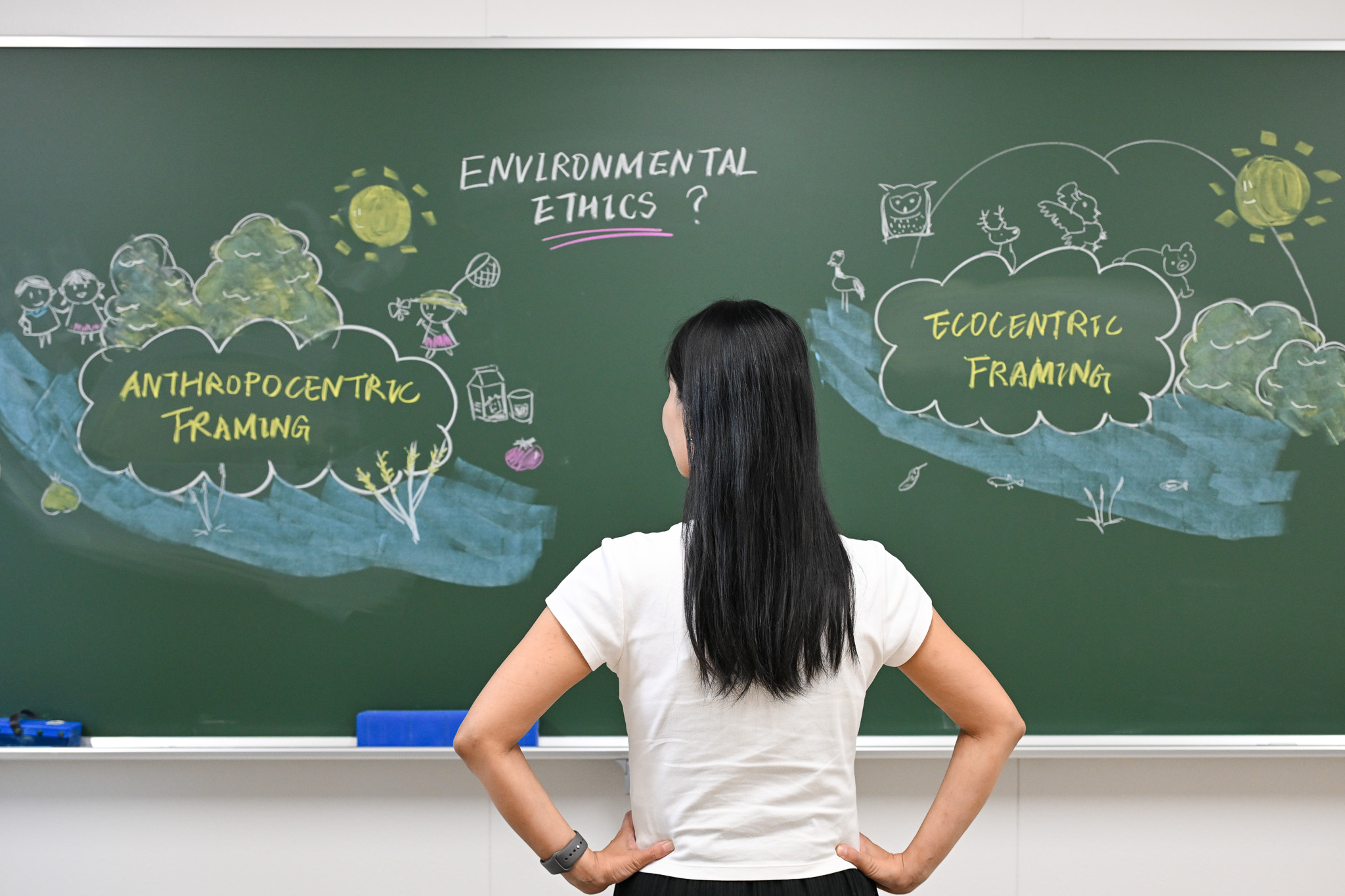
A randomized trial in 21 Japanese elementary schools shows, for the first time, that framing the environment around human benefit raises more student interest than framing nature around its intrinsic value.
###
For more information about this research, see “Does the framing of environmental ethics matter for the effectiveness of environmental education? Evidence from field experiments in elementary schools,” Akinori Kitsuki, Yoichiro Miki, Chiyoko Nagatani, Kazuhiro Nomoto, Toshio Sadakuni, Shigeharu Terui, Satoru Uchida, Asuka Yamamoto, Yuichiro Fujioka, Ecological Economics, https://doi.org/10.1016/j.ecolecon.2026.109150
Research-related inquiries
Akinori Kitsuki, Associate Professor
Faculty of Arts and Science
Contact information can also be found in the full release.
- TOP
- News
- Research Results
- The framing of nature changes how kids respond to environmental education