


































研究成果 Research Results
- TOP
- News
- Research Results
- Saline Lakes: Overlooked Ecosystems with Global Conservation Value
 Saline Lakes: Overlooked Ecosystems with Global Conservation Value
International study published in Nature Communications highlights the biodiversity and ecosystem services of saline lakes
Associate Professor Maria Belen Alfonso
Research Institute for Applied Mechanics
2026.09.09Research ResultsEnvironment & Sustainability
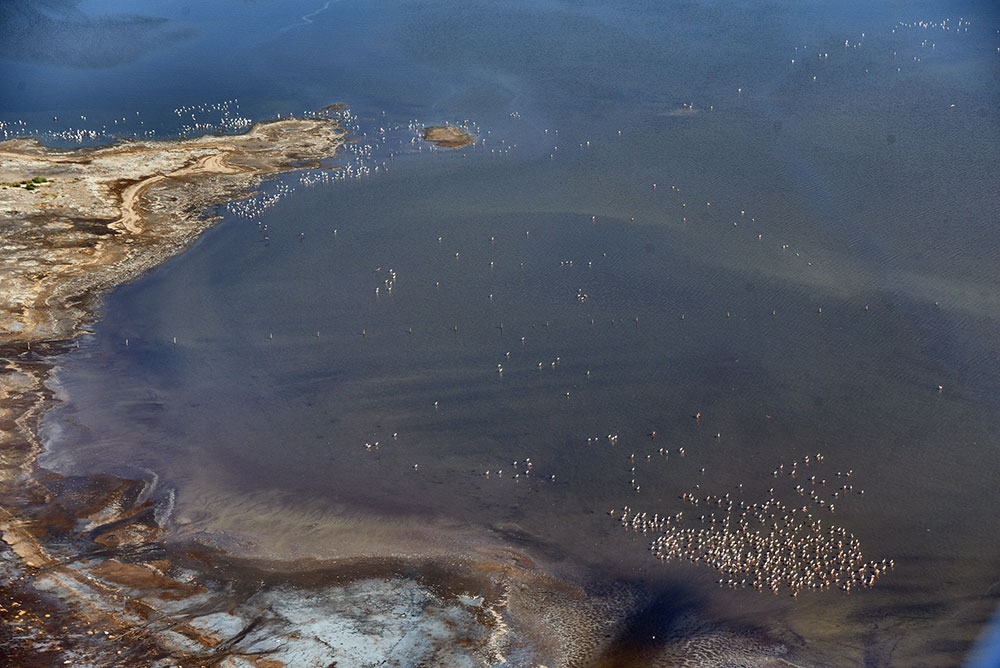
Saline lakes account for nearly half of the global volume of lake water and are among the most environmentally sensitive aquatic ecosystems, yet their ecological and societal importance remains widely underestimated. A new international study, published in Nature Communications, challenges this perception by assessing the conservation value and ecosystem services of 85 saline lakes distributed across the globe.
The study brings together 64 researchers from 20 countries and combines scientific expertise and regional knowledge to evaluate threatened species, ecosystem services, and the management challenges associated with saline lakes. The results show that these ecosystems support a much broader range of biodiversity and human benefits than is often recognized.
The global assessment was made possible through contributions from researchers with expertise in saline lakes from different regions of the world. Associate Professor María Belén Alfonso, at Kyushu University’s Research Institute for Applied Mechanics (RIAM), contributed information on saline lake ecosystems in Argentina, drawing on research conducted there earlier in her scientific career.
“Saline lakes are often treated as marginal environments, but the number of ecosystem services does not fall as salinity rises; the type of service changes instead. In dry regions there is no substitute for these lakes, and that is why management has to look at the whole catchment rather than the shoreline,” explains Alfonso.
The full release can be found here:
http://isslr.org/saline-lakes-of-the-world-hidden-treasures-of-biodiversity-under-threat/
###
For more information about this research, see "The overlooked conservation values of saline lakes," Alfred Burian, Ramesh Wilson, Pavel Kratina, Örs Ábrám, Ekaterina Afonina, Javier Alcocer, María Belén Alfonso, …Egor Zadereev et al., Nature Communications, https://doi.org/10.1038/s41467-026-76684-0
Research-related inquiries
María Belén Alfonso, Associate Professor
Research Institute for Applied Mechanics (RIAM)
Contact information can also be found in the full release.
- TOP
- News
- Research Results
- Saline Lakes: Overlooked Ecosystems with Global Conservation Value