

































研究成果 Research Results
- TOP
- News
- Research Results
- A new metal-free and water-soluble molecule that can produce fluorescence and be used as MRI contrast material
 A new metal-free and water-soluble molecule that can produce fluorescence and be used as MRI contrast material
Researchers modify luminescent organic radicals to develop water-soluble compounds that have dual use as fluorescence material and MRI contrast material
Associate Professor Albrecht Ken
Institute for Materials Chemistry and Engineering
2026.09.28Research ResultsLife & HealthPhysics & ChemistryMaterials
Fukuoka, Japan—Bioimaging technologies, such as fluorescence imaging (FI) and magnetic resonance imaging (MRI), are powerful techniques utilized in both basic research and clinical medicine. However, they have their drawbacks. FI allows researchers to visualize cells and other biological processes with high resolution, but it lacks imaging depth. MRIs, on the other hand, can capture images deep within the body, but they lack the single-cell-level resolution provided by FI. Furthermore, MRI contrast agents contain paramagnetic metals, such as gadolinium, that can potentially cause adverse side effects.
Publishing in the journal Advanced Science, a research team led by Kyushu University has developed a new water-soluble and metal-free molecule that can be detected by fluorescence imaging and used as an MRI contrast agent. The findings open the possibility of safer, multifunctional, and less toxic imaging agents in addition to applications in other bioimaging techniques.
“In this study, we developed a molecule with both FI and MRI functionality. However, creating such a molecule is challenging because the functional mechanisms of the two technologies differ,” explains Associate Professor Ken Albrecht from Kyushu University’s Institute for Materials Chemistry and Engineering, who led the study. “In FI, a molecule absorbs and reemits certain wavelengths of light that we then detect. MRIs work by detecting the molecular spin of the hydrogen atoms in water molecules in the body. The contrast material helps improve the clarity of the resulting image.”
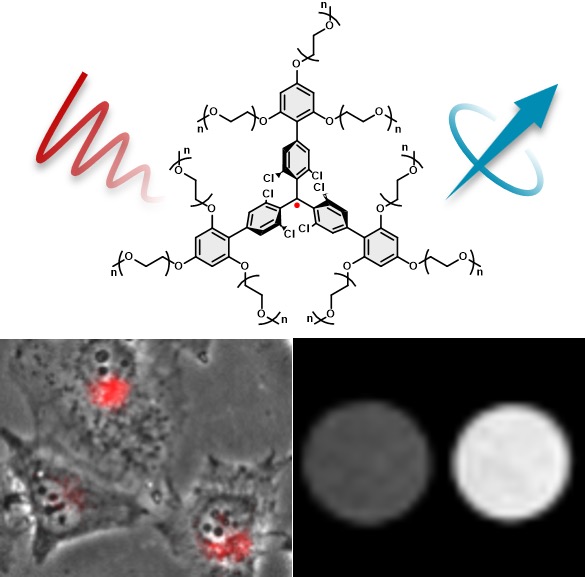
The team focused on a promising series of molecules called luminescent organic radicals, which have been shown to produce fluorescence and molecular spin. However, previous studies showed that these molecules were hydrophobic, which limited their utility in biological systems.
“We worked with a molecule called tris(2,4,6-trichlorophenyl) methyl (TTM), a luminescent organic radical that produces fluorescence and functions as an MRI contrast agent,” continues Albrecht. “The first generation of molecules we made showed good MRI activity, but had extremely weak fluorescence. We continued to optimize the molecule to make it water-soluble and improve its fluorescence activity.”
The team eventually developed two molecules: TTM-tisTP3B and TTM-trisTP9B. Both molecules are bound in three directions to water-soluble groups and produce deep-red fluorescence in water. TTM-trisTP3B was tested in living cells and was confirmed to emit fluorescence around the cell nucleus and continued to fluoresce for at least 24 hours. Both molecules enhanced the contrast of MRI phantom images approximately 2.5 to 4.5 times more than previously reported water-soluble TTM radicals.
While the full utility of these new molecules still needs to be investigated, these findings introduce a new strategy that unifies fluorescence with MRI function and can potentially improve the future of bioimaging in both basic research and medical diagnostics.
“We will have to perform animal studies to further examine the viability of these molecules, but the present results establish important proof of concept for metal-free fluorescence/MRI dual-modal imaging,” concludes Albrecht. “Luminescent organic radicals have attracted attention in quantum information science, quantum sensing, and advanced electronic materials. These results may also serve as a foundation for future quantum sensing technologies.”
###
For more information about this research, see "Water-Soluble Luminescent Trityl Radical for Fluorescence/Magnetic Resonance Dual-Modal Imaging Probe," Kosuke Anraku, Satoshi Okada, Akira Sumiyoshi, Kenshiro Matsuda, Kazuhiro Nakamura, Takuya Hosokai, Ken Albrecht, Advanced Science, https://doi.org/10.1002/advs.77710
Research-related inquiries
Ken Albrecht, Associate Professor
Institute for Materials Chemistry and Engineering
Contact information can also be found in the full release.
- TOP
- News
- Research Results
- A new metal-free and water-soluble molecule that can produce fluorescence and be used as MRI contrast material