


































研究成果 Research Results
- TOP
- News
- Research Results
- The softening of an embryo’s nucleus after the very first division is critical for further development
 The softening of an embryo’s nucleus after the very first division is critical for further development
Researchers find that nuclear softening at an embryo's two-cell stage is vital for major zygotic gene activation and proper embryonic development
Professor Kei Miyamoto
Faculty of Agriculture
2026.11.12Research ResultsLife & HealthPhysics & Chemistry
Fukuoka, Japan—A research team led by Kyushu University and the National Institute of Genetics has discovered that during the two-cell stage of mouse embryonic development, the embryo’s nucleus softens and deforms. This nuclear softening is an integral part of major zygotic gene activation, where approximately 2,000 genes necessary for embryonic development activate simultaneously. This indicates that nuclear softening is a critical step for further embryonic development. These findings were made possible thanks to a new method the team invented to measure and manipulate the softness of the embryonic nucleus.
This discovery, published in the journal Nature, provides new insights into the role of cell nuclei's physical properties in early embryonic development, and has the potential to lead to better analytical methods for identifying viable embryos used in IVF and even studying diseases associated with nuclear malformation such as cancer.
The cells that make up our bodies have a structure called the nucleus that houses our DNA. The structure of the nucleus is supported by molecules that form the nuclear envelope. Depending on the cell's lifecycle or role in the body, the nuclear envelope can change in rigidity and structure. If the nuclear envelope is not properly maintained, it can lead to cellular dysfunction.
“Abnormal nuclear shape is used for histological diagnosis and characterization of cancer. Some cancer cells have soft nuclei, which, in theory, enables them to leave their environment and travel to other parts of the body. This phenomenon is called metastasis,” explains Professor Kei Miyamoto of Kyushu University’s Faculty of Agriculture, who co-led the study with Associate Professor Yuta Shimamoto at the National Institute of Genetics. “While we know that nuclear structure is important to life, we knew little about its role at the earliest stages of development, at the very beginning of life. We wanted to find out how the nucleus changes during the first few days after fertilization.”
To accomplish this, the team had to invent a method of measuring the hardness of a nucleus without destroying it. They developed a nanocapillary-based measurement system in which a thin glass tube smaller than the nucleus is inserted into the cell and attached to its surface. A small suction force captures the nucleus through the capillary, causing the surface to deform and stretch.
“This nanocapillary system that was developed by the Shimamoto lab allowed us to measure the stiffness of a cell’s nucleus,” continues Miyamoto. “We began testing how the physical property of mouse embryonic nuclei changes right after fertilization. When a sperm cell enters an egg, the two nuclei fuse to form a single nucleus. Over the next 48 hours, it divides twice, first reaching the two-cell stage, and then the four-cell stage.”
The team found that, during the two-cell stage, the nucleus becomes considerably deformed. They measured nuclear stiffness with the new nanocapillary system and found that it starts out with high stiffness during the one-cell stage, and then becomes considerably softer and plastic during the two-cell stage. However, it would return to the original stiffness at the four-cell stage. Further analysis showed that Lamin B1, a protein that gives the nuclear envelope its structure, was being cleared at the two-cell stage, resulting in softening of the nucleus. Interestingly, cells whose nuclei did not soften at the two-cell stage were considerably less likely to develop further.
“This was a very interesting finding. We knew that the two-cell stage is a critical time in embryonic development when a phenomenon called major zygotic genome activation, or ZGA, occurs. This is when over 2,000 genes become active almost simultaneously, kickstarting the development of the embryo,” explains Miyamoto. “Upon further investigation, we found that nuclear softening itself helps facilitate the expression of ZGA genes."
Examining the dynamics of genes during nuclear softening revealed that necessary genes shifted around within the nucleus. If the nucleus was stiff, positional changes of gene loci were restricted. Furthermore, active DNA transcription occurred near the softened nuclear envelope, but in embryos with stiffened nuclei, transcription of ZGA genes in that region was inhibited.
This study demonstrates that the physical properties of a cell’s nucleus can influence gene function and normal embryonic development. Future research will investigate whether this occurs in other animals, including humans.
“This is a great fundamental discovery for the field of developmental biology and holds significant potential in applied research,” concludes Miyamoto. “In the future, we hope this will lead to a better way of evaluating viable embryos in procedures such as IVF, and even to new tools for studying the physical properties of cancer cells.”
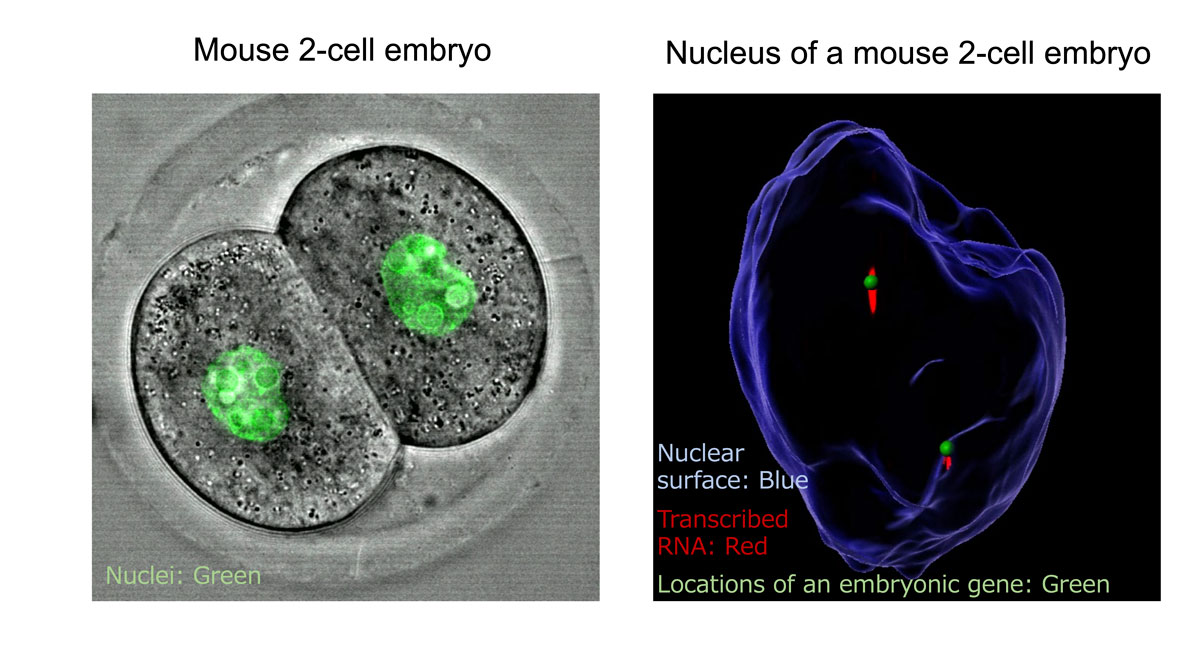
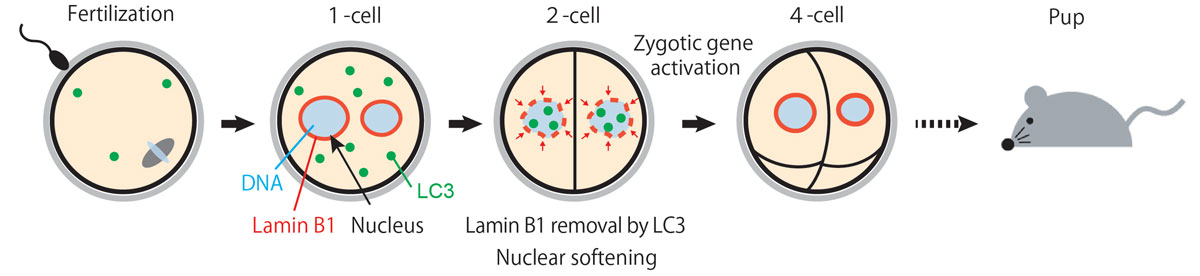
###
For more information about this research, see "Transient Nuclear Softening for Zygotic Gene Activation in Mice," Masahito Tanaka, Rin Sakanoue, Yasuki Miyagawa, Kai Otsuka, Yoshiaki Kobayashi, Atsushi Takasu, Ryunosuke Mori, Naoko Watanabe, Akihiro Inoue, Koyo Ikeda, Yu-Chia Chen, Aussie Suzuki, Yasuyuki Ohkawa, So Maezawa, Hiroshi Ochiai, Kei Miyamoto, & Yuta Shimamoto. Nature, https://doi.org/10.1038/s41586-026-11240-w
Research-related inquiries
Kei Miyamoto, Professor
Faculty of Agriculture
Contact information can also be found in the full release.
- TOP
- News
- Research Results
- The softening of an embryo’s nucleus after the very first division is critical for further development