


































研究成果 Research Results
- TOP
- News
- Research Results
- Companies’ progress on climate reporting gets lost in the average
 Companies’ progress on climate reporting gets lost in the average
A decade of climate reporting scores from 8,959 firms reveals how a widening reporting population masks improvements among those assessed over time
Associate Professor Alexander Ryota Keeley
Faculty of Engineering
2026.10.30Research ResultsHumanities & Social SciencesMath & DataEnvironment & Sustainability
Fukuoka, Japan—Companies are increasingly expected to explain the climate risks and how they are responding. CDP, formerly the Carbon Disclosure Project, is a leading nonprofit that collects and scores corporate environmental disclosures, including emissions data, climate risks, and governance practices. How has CDP’s average score changed year by year, and does that trend capture the progress of companies that have disclosed consistently for many years?
Kyushu University researchers analyzed a decade of CDP climate scores and found that gains among the firms assessed in both 2016 and 2025 improved much more than the overall average suggested. Expanding coverage brought in lower-scoring newcomers, obscuring those gains. Published in Corporate Social Responsibility and Environmental Management on October 14, 2026, the research offers investors, companies and rating providers a clearer way to track changes in climate disclosure quality and interpret broader trends as reporting expands.
Separating progress from a changing population
“Founded in 2000, CDP has built an extensive record of corporate climate disclosure,” says Associate Professor Alexander Ryota Keeley of Kyushu University’s Faculty of Engineering. “While average scores give us a broad picture of reporting trends, the companies being assessed change over time, which can mask progress within individual companies.”
To uncover these hidden changes, Keeley’s team analyzed ten years of CDP climate scores for 8,959 companies, covering 37,450 firm-year observations between 2016 and 2025. By linking company records across years, they separated score changes among “stayers,” assessed in both 2016 and 2025, from the effects of “entrants,” assessed in 2025 but not in 2016, and “exiters,” assessed in 2016 but not in 2025.
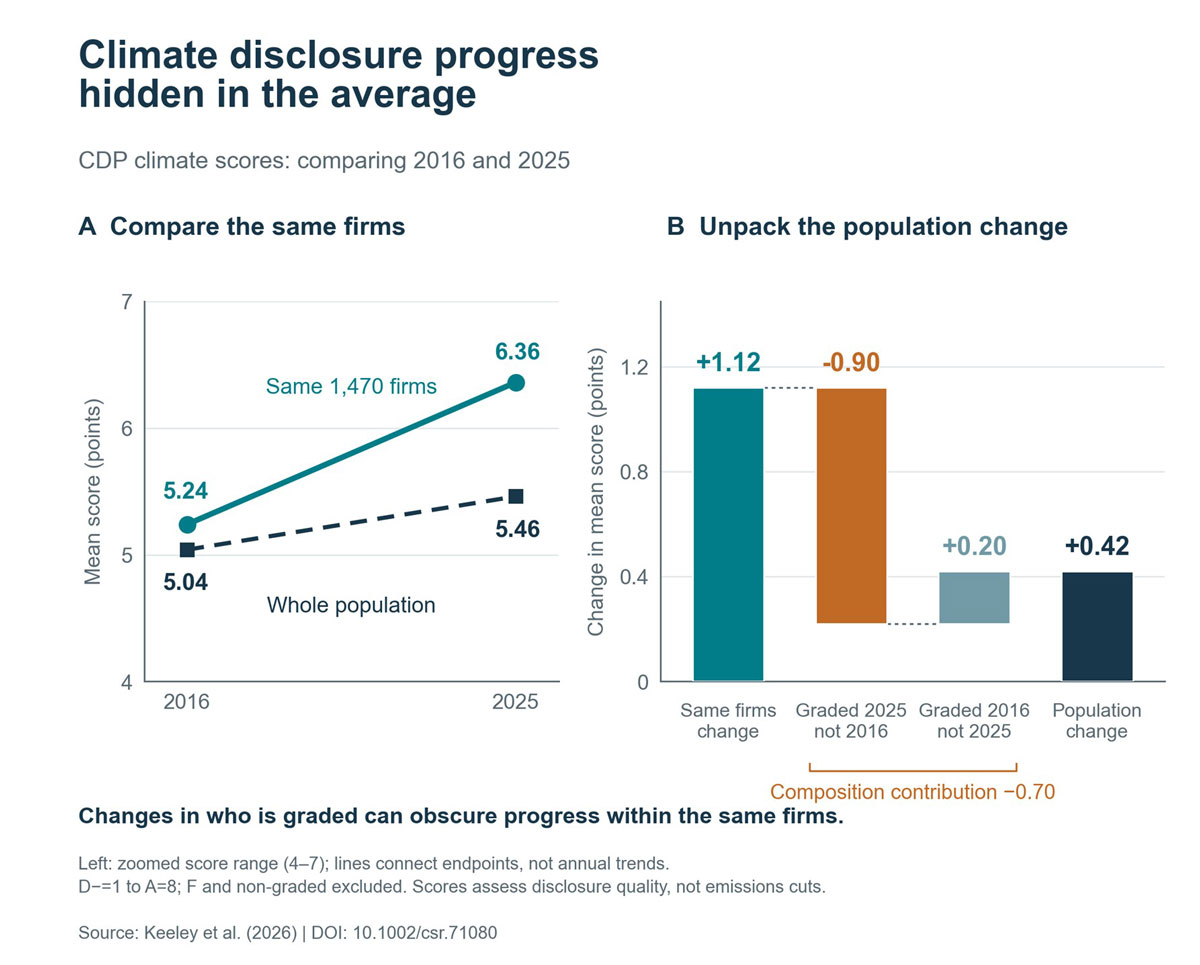
After converting CDP’s eight grades, from D− to A, into a numerical scale of 1 to 8, the researchers found that the overall mean score rose by 0.42 points, from 5.04 to 5.46. Yet the 1,470 stayers gained 1.12 points, the mean increased from 5.24 to 6.36—nearly three times the overall increase.
The changing mix of companies explains the gap. Entrants scored below stayers in 2025, reducing the overall increase by 0.90 points. Exiters also scored below stayers in 2016, so their absence in 2025 contributed a positive 0.20 points. Together, these changes offset 0.70 points of the improvement, masking much of the progress among the stayers.
“The findings suggest that sustained reporting, supported by strong governance and reliable data systems, may help companies improve their disclosures over time,” adds Keeley.
A clearer benchmark for disclosure
Beyond score trends, the team examined how the content of companies’ written responses related to their scores in 2024–2025. Using measures such as response length, numerical density, and hedging expressions, they built a Textual Detail Index (TDI) and found that more detailed answers were associated with higher scores.
The team plans to expand its research to environmental issues such as water and forests by combining multiple datasets to compare corporate reporting across these areas. By integrating existing data with new datasets of their own, the researchers hope to uncover links between corporate performance and wider social impacts that a single dataset may miss.
“For companies, we hope our research highlights the importance of strong governance and a lasting commitment to tracking and reporting data,” says Keeley. “For investors, looking beyond the averages to companies’ governance and long-term commitments can help reveal where progress is being made and where challenges remain.”
###
For more information about this research, see “The Hidden Arithmetic of Climate Disclosure: How a Decade of CDP Climate Scores Masks a Large Within-Firm Rise and an Equally Large Composition Drag,” Alexander Ryota Keeley, Jun Xie, Hidemichi Fujii, Shunsuke Managi, Corporate Social Responsibility and Environmental Management, https://doi.org/10.1002/csr.71080
Research-related inquiries
Alexander Ryota Keeley, Associate Professor
Faculty of Engineering
Contact information can also be found in the full release.
- TOP
- News
- Research Results
- Companies’ progress on climate reporting gets lost in the average