


































研究成果 Research Results
- TOP
- News
- Research Results
- Developing a theoretical model to understand how isotopes change spectroscopy results
Developing a theoretical model to understand how isotopes change spectroscopy results
Researchers investigate how oxygen isotopes in forsterite (Mg2SiO4) affect Raman spectroscopy results to develop a theoretical framework for better interpretation of spectral dataAssociate Professor Masashi Arakawa
Faculty of Science
2026.06.09Research ResultsPhysics & Chemistry
Fukuoka, Japan—When researchers want to uncover what atoms make up a material, they turn to a number of tried-and-true spectroscopy methods. Spectroscopy works by shining a specific type of light onto a substance and then analyzing how that light is either absorbed, emitted, or scattered. Every atom has a different way of interacting with light, and scientists study this light-matter interaction to identify the atoms in the material.
In many cases, isotopes in a material can be used to determine its origin or age. Raman spectroscopy has been a promising method to detect isotopes because it identifies atoms based on their mass. Additionally, the method allows for the analysis of small and rare materials, like meteorites, without destroying the sample. However, the lack of a theoretical framework for describing isotope effects in Raman spectra has hindered the broader application of this technique.
Publishing in The Journal of Physical Chemistry C, Associate Professor Masashi Arakawa from Kyushu University’s Faculty of Science investigated how oxygen isotopes in silicate minerals can affect the results of Raman spectroscopy and developed a theoretical framework to enable better interpretation of the results.
“In Raman spectroscopy, atoms show up as specific frequencies based on their atomic weight. Previous studies have shown that isotopes cause the frequencies to shift, but those results primarily focused on artificial materials or ones with specific compositions,” explains Arakawa. “Samples in nature have low isotope concentrations which are distributed across the material randomly.”
Arakawa aimed to bridge this gap by investigating how oxygen isotopes in a material called forsterite (Mg2SiO4) cause frequency shifts.
He found that, first, heavier isotopes shift vibrational frequencies to lower wavenumbers due increased in mass. Second, the presence of oxygen isotopes lowers the symmetry of the material, activating vibrational modes that were previously invisible to Raman spectroscopy. Third, the location of oxygen isotopes within the material strongly influences the vibrational modes, leading to peak splitting. Finally, because the isotopes are randomly distributed, the spectroscopy will produce broader peaks.
“By identifying these key mechanisms, we now have a framework for better interpretation of Raman spectra data,” concludes Arakawa. “Thanks to these results, we can get better at analyzing different materials from nature, especially where conventional isotope analysis is a challenge. I hope these new findings provide a better understanding of vibrational spectroscopy in complex solids and will help elucidate the origins and composition of exotic materials like meteorites and extraplanetary materials.”
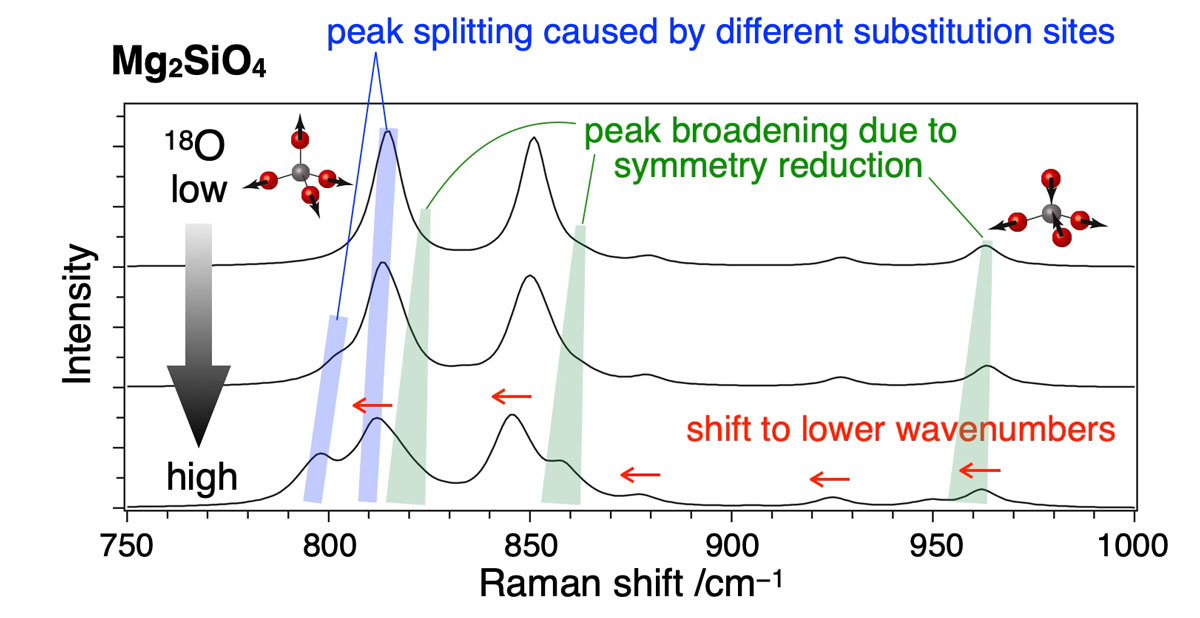
As the proportion of oxygen isotopes increases, the peak shifts toward lower wavenumbers; peak splitting occurs due to differences in the substitution sites; and peak broadening results from a decrease in symmetry
###
For more information about this research, see "Computational Analysis of Oxygen Isotope Effects on the Raman Spectra of Forsterite (Mg2SiO4)," Masashi Arakawa, The Journal of Physical Chemistry C, https://doi.org/10.1021/acs.jpcc.5c08487
Research-related inquiries
Masashi Arakawa, Associate Professor
Faculty of Science
Contact information can also be found in the full release.
- TOP
- News
- Research Results
- Developing a theoretical model to understand how isotopes change spectroscopy results