


































研究成果 Research Results
- TOP
- News
- Research Results
- Using atomic clocks to reveal the quantum properties of time
Using atomic clocks to reveal the quantum properties of time
Associate Professor Joshua Foo
Institute for Advanced Study
2026.05.15Research ResultsPhysics & ChemistryTechnology
Fukuoka, Japan—In our day-to-day lives, we recognize the movement of time as hands spinning around a clock or digits rolling on a phone. But the nature of time remains one of the deepest questions in physics. You’ve probably heard how in Einstein’s theory of relativity, time flows differently depending on speed and gravity.
When quantum mechanics is involved, time gets trickier. At that level, a clock’s motion can exist in “superposition,” where the different flows of time all exist at the same moment. However, this interplay of time between relativity and quantum physics has never been observed experimentally.
Publishing in Physical Review Letters, researchers from Kyushu University, in collaboration with the Stevens Institute of Technology, University of Waterloo, the National Institute of Standards and Technology, Colorado State University, and Stockholm University, designed a theoretical framework showing that current state-of-the-art trapped-ion atomic clocks can be used to observe this “quantum superposition of times.”
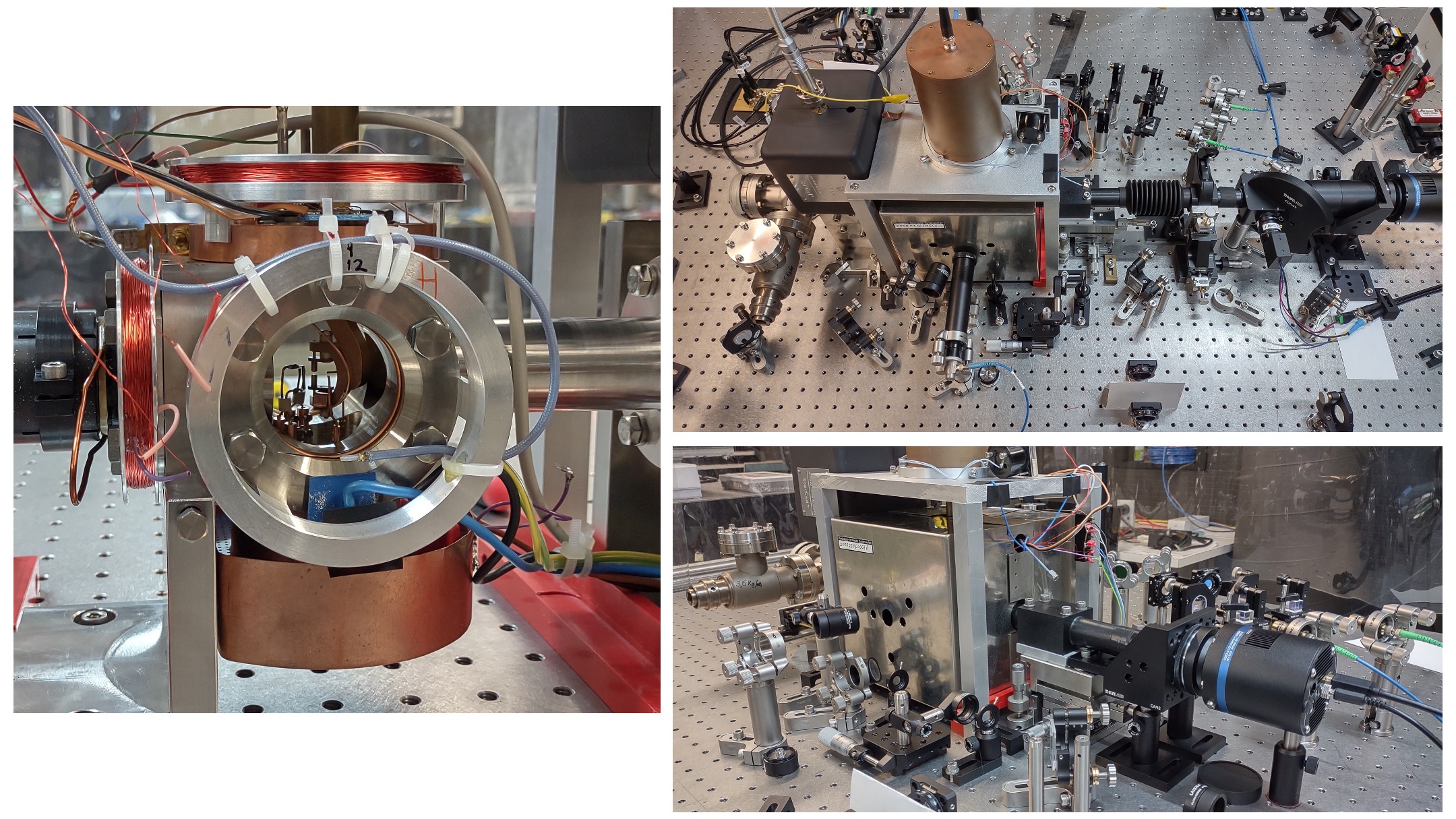
Pictures of the components used in making an atomic clock. Pictures of the components used in making an atomic clock. The ion trap (left image) holds the clock in place. The optical/laser apparatus (right images) measures the clock’s frequency.
Atomic clocks are a type of super-precise clock that measure time by monitoring the frequency of certain atoms. Because of their precision, they are fundamental to modern technologies such as GPS. In fact, they have become so precise and sensitive that they can detect the time dilation predicted by Einstein’s theory over a height difference of a few millimeters.
“It’s the precision that led us to develop our theoretical model. We found that the atomic clock's motion becomes “entangled” with its internal energy. The signature of this entanglement is that the clock itself loses some of its quantum properties, which can be detected using modern techniques,” explains Associate Professor Joshua Foo of Kyushu University’s Institute for Advanced Studies and one of the lead authors of the paper. “We introduced a new technique for controlling the atomic clock’s motion, improving its sensitivity to this effect by 100 to 1000 times.”
The work establishes that atomic clocks can be used as a platform to explore the quantum nature of time, and opens a new experimental frontier in fundamental physics, as well as leading to more precise next-generation clocks.
“Naturally, bringing our theoretical model to reality is the big next step, and developing a detailed experiment that accounts for real-world unpredictability will give us further insight into our model,” concludes Foo. “We are also interested in exploring whether atomic clocks could eventually be used to probe the quantum realm of gravity, the other fundamental question in physics.”
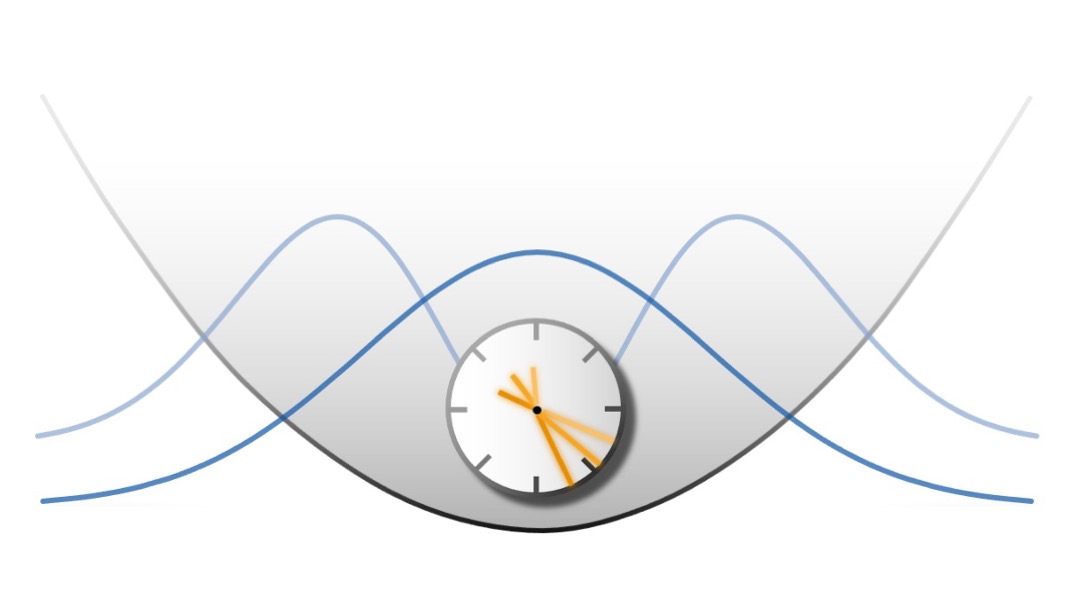
A diagram illustrating the classical, semi-classical, and quantum intrinsic-time dynamics of the trapped-ion atomic clock reported in the study. This figure shows how the clock and spatial relativistic dynamics interfere.
###
For more information about this research, see "Quantum Signatures of Proper Time in Optical Ion Clocks," Gabriel Sorci, Joshua Foo, Dietrich Leibfried, Christian Sanner, and Igor Pikovski, Physical Review Letters, https://doi.org/10.1103/qhj9-pc2b
Research-related inquiries
Joshua Foo, Associate Professor
Institute for Advanced Studies
Contact information can also be found in the full release.
- TOP
- News
- Research Results
- Using atomic clocks to reveal the quantum properties of time