































研究成果 Research Results
- TOP
- News
- Research Results
- What dental calculus can tell us about the oral microbiomes of ancient Japan
What dental calculus can tell us about the oral microbiomes of ancient Japan
Microbe DNA from ancient dental calculus offers insights into past oral microbiomes of the Japanese people, including the phylogeny of the periodontal disease-associated archaeon, M. oraliAssociate Professor Shiori Yonemoto / Associate Professor Kyoko Funahashi
Kyushu University Museum/Faculty of Social and Cultural Studies
2026.06.29Research ResultsHumanities & Social Sciences
Researchers characterized the oral microbiomes of the Japanese population across time by analyzing the DNA preserved in dental calculus of human skeletal remains. The researchers compared microbial composition in dental calculus primarily from Edo-period individuals with that of modern dental calculus, and identified differences associated with time period, region, and the phylogeny of several oral bacterial species. The findings show that dental calculus can provide new avenues for examining human history and the relationships between humans and microorganisms.
Researchers at Toho University, the University of Tokyo, Kyushu University, and collaborating institutions characterized the oral microbiomes of the Japanese population during the Edo period (1603-1868) by analyzing the DNA preserved in dental calculus from human skeletal remains. Additionally, the researchers compared microbial composition in dental calculus from ancient to modern individuals and identified the differences associated with time period, region, and the phylogeny of several oral bacterial species.
They also conducted a phylogenetic analysis of the periodontal disease-associated archaeon Methanobrevibacter oralis (M. oralis) and found that the archaea present in the blackened teeth of Edo-period women—a process known as ohaguro—belonged to the same clade. These findings suggest that microbial DNA preserved in dental calculus can provide new evidence for examining past diet, regional variation, cultural practices, and the history of relationships between humans and microorganisms. The study was published in Scientific Reports.
The full release can be found here:
https://www.eurekalert.org/news-releases/1130671
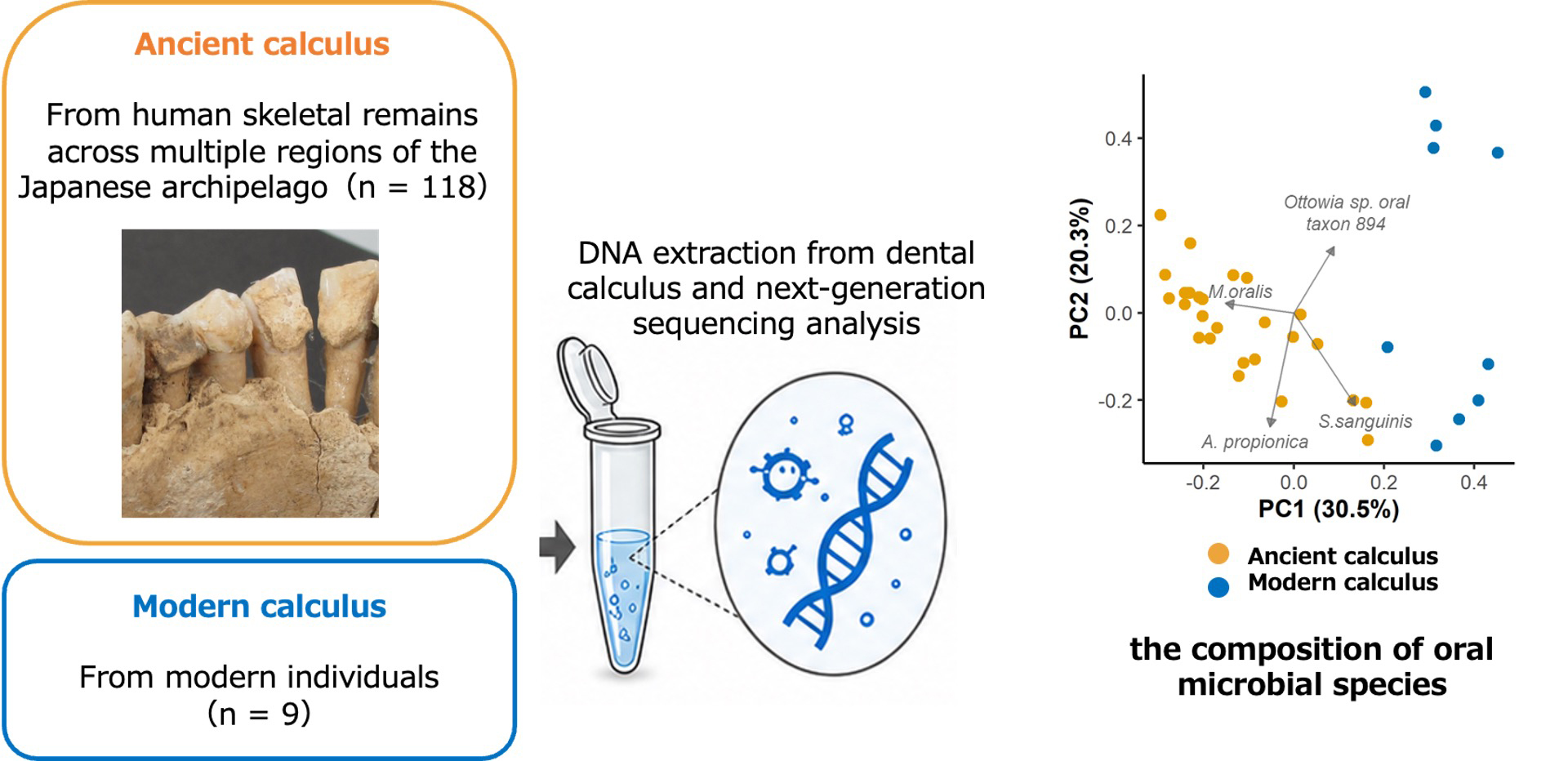
This figure compares the oral microbial composition of ancient dental calculus—mainly from Edo-period individuals—with that of modern samples, combining newly generated data with previously published datasets.
Research-related inquiries
Shiori Yonemoto, Associate Professor
Kyushu University Museum
Kyoko Funahashi, Associate Professor
Faculty of Social and Cultural Studies
Contact information can also be found in the full release.
- TOP
- News
- Research Results
- What dental calculus can tell us about the oral microbiomes of ancient Japan