


































研究成果 Research Results
- TOP
- News
- Research Results
- New method enables accurate sequencing of short peptides hidden in food and human body
 New method enables accurate sequencing of short peptides hidden in food and human body
A new chemical tagging approach enables direct, reliable sequencing of short peptides without relying on databases, opening new possibilities for food science, nutrition, and biomedical research
Professor Mitsuru Tanaka
Faculty of Agriculture
2026.06.16Research ResultsLife & Health
Fukuoka, Japan—Our food and our bodies are full of tiny protein fragments called peptides. These small chains of amino acids act as biological messengers, influencing processes ranging from sensory perception to physiological functions.
Recent advances in omics technologies have provided unprecedented insights into the molecular processes that shape living systems, revealing these molecules as key players across a wide range of biological functions. However, accurately sequencing short peptides remains challenging because their small size provides limited analytical information. In addition, many conventional identification methods largely rely on matching data against known protein sequence databases, making it difficult to identify novel peptides that are not already cataloged. A more direct approach, one that can decode unknown sequences without leaning on existing databases, has long been needed.
In the present study, published in Analytical Chemistry on June 15, 2026, Associate Professor Mitsuru Tanaka from Kyushu University’s Faculty of Agriculture and his team developed an innovative approach to this problem. Their method uses mass spectrometry, an analytical technique that identifies compounds by measuring the mass-to-charge ratios of ions generated from a sample. At its core is de novo sequencing, which reads peptide sequences directly from raw data, making it possible to identify novel sequences that conventional methods would miss.
The new strategy works by attaching a coumarin-derived tag to the N-terminus, one end of peptides. Specifically, the researchers used N-succinimidyl 7-methoxycoumarin-3-carboxylate (Me-Cou) as the tagging reagent. This tag causes the peptide to break apart in a more predictable, stepwise fashion during mass spectrometry analysis, generating clearer patterns that can be read like a ladder to determine the sequence of each peptide.
“Using our approach, the amino acid sequence of peptides can be determined step by step, starting from the tagged end, enabling highly accurate characterization of even the short ones,” explains Tanaka.
To evaluate the applicability of the Me-Cou-aided sequencing method, the researchers analyzed 132 standard peptides with known sequences. The results showed that conventional methods correctly identified only 42 of 86 dipeptides and 25 of 46 oligopeptides, and produced 32 misidentifications. In contrast, the new method successfully identified all 132 peptides with zero errors, highlighting both its accuracy and reliability.
The team then applied the method to casein peptone, a complex peptide mixture derived from milk proteins as a model for evaluating sequencing performance. Compared with conventional methods, this approach significantly increased the number and diversity of identified sequences, particularly short peptides consisting of two to ten amino acids.
“These results demonstrate the accuracy of our approach and its potential for analyzing complex, real-world samples such as fermented foods like sake and soy sauce, as well as biological samples including blood and urine,” remarks Tanaka.
Overall, the new method provides a powerful tool for identifying short peptides that have long been difficult to analyze. By enabling a more comprehensive characterization of peptides in foods and biological samples, the approach could support future advances in food science, nutrition, biochemistry, and biomedical research.
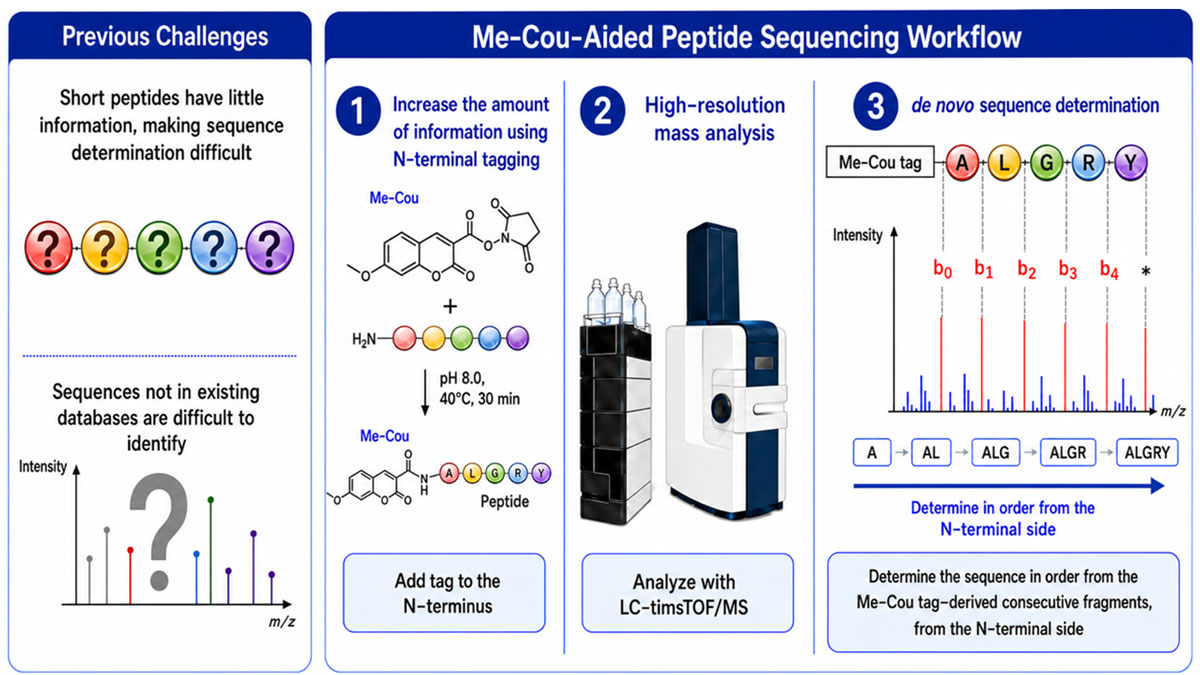
The proposed workflow enables accurate and reliable de novo sequencing of short peptides directly from mass spectrometry data, without relying on existing sequence databases.
###
For more information about this research, see "N-terminal Coumarin Derivatization-Aided De Novo Peptide Sequencing and Its Application to Peptidomics Using LC-Trapped Ion Mobility Spectrometry-qTOF/MS”, Hui Luan, Yumiko Toyama, Fumiya Honda, Ryotaro Asai, Risa Katagihara, Yizhi Xiao, Saya Nakamura, Toshiro Matsui, and Mitsuru Tanaka, Analytical Chemistry, https://doi.org/10.1021/acs.analchem.6c01542.
Research-related inquiries
Mitsuru Tanaka, Associate Professor
Faculty of Agriculture
Contact information can also be found in the full release.
- TOP
- News
- Research Results
- New method enables accurate sequencing of short peptides hidden in food and human body