


































研究成果 Research Results
- TOP
- News
- Research Results
- Selective microwave heating speeds bamboo-to-hydrogen fuel conversion
Selective microwave heating speeds bamboo-to-hydrogen fuel conversion
Experiments reveal microwaves create localized hot spots on catalyst particles, boosting biomass conversion and paving the way for electrified, low-carbon chemical manufacturingProfessor Shuntaro Tsubaki
Faculty of Engineering
2026.08.03Research ResultsEnvironment & Sustainability
Fukuoka, Japan—Researchers at Kyushu University have shown that microwave (MW) radiation can dramatically speed up the conversion of biomass into useful gases by creating localized high-temperature regions on nickel nanoparticles. Using advanced X-ray techniques to observe the catalyst during conversion reactions, the team found that these microscopic, localized hot spots form on the catalyst even when the surrounding material remains much cooler, helping explain why MW-assisted catalytic reactions can outperform conventional heating.
Wood, straw, and other biomass are abundant, renewable alternatives to fossil fuels, but converting them into useful gases like hydrogen has long been inefficient. Finding faster, more efficient ways to convert biomass into useful chemicals is an important step toward a carbon-neutral society.
One common approach is pyrolysis, where biomass is heated without oxygen to break down into gases, liquids, and solid carbon. However, conventional heating is slow and energy-intensive because heat must gradually travel from the outside in.
MW heating stands out as a promising alternative because it transfers energy directly into materials that absorb MW radiation. Previous studies suggested that microwaves could accelerate catalytic reactions by heating metal nanoparticles more strongly than their surroundings, creating chemically favorable conditions. However, direct experimental evidence for these localized temperature differences remained limited, leaving it unclear why MW-assisted reactions often outpace conventional heating.
To this end, a research team led by Professor Shuntaro Tsubaki from Kyushu University’s Faculty of Engineering collaborated with researchers from The University of Osaka, Institute of Science Tokyo, High Energy Accelerator Research Organization (KEK), and International Christian University. Their study, published online in Chemical Engineering Journal on July 7, 2026, examines how precisely controlled microwaves interact with nickel catalysts during biomass pyrolysis.
Using a solid-state MW generator to precisely control MW frequency, the team mixed cellulose and bamboo powder with a commercial nickel catalyst (Ni/SiO2-Al2O3) and compared MW heating with conventional heating. They employed in situ X-ray absorption fine structure (XAFS), which measures the local atomic environment around specific elements, and in situ X-ray diffraction (XRD), which reveals changes in crystal structure. These techniques enabled them to monitor the catalyst while MW irradiation was taking place.
The experiments showed that MW heating, when properly tuned, accelerated hydrogen production by more than six times compared with conventional heating. The XAFS measurements indicated that the nickel particles reached temperatures up to 80°C higher than those of the surrounding material during MW heating.
Even more strikingly, the XRD data showed that the nickel particles fused together through a process called sintering at bulk temperatures of 350–400°C under MW irradiation, whereas this normally requires temperatures of 1,000°C or higher under conventional heating conditions. This shows that the true temperature at the nickel surface was substantially higher than what could be measured externally. “Our findings provide rare, experimentally grounded insight into how microwaves interact with catalytic nanoparticles during reactions,” says Tsubaki.
Overall, these insights could help engineers leverage MW-assisted biomass conversion in real time. “One promising application is the rapid, electricity-driven production of hydrogen and light gases from agricultural and forestry residues, enabling compact, local energy systems that do not rely on large external furnaces,” notes Tsubaki. He also notes that MW-driven chemical catalysis simultaneously enables higher reaction rates, selectivity control, and catalytic activation mechanisms that were previously inaccessible.
The same MW-heating principle could also extend to other high-temperature catalytic processes that currently rely on conventional furnaces. Examples include the breakdown of mixed plastic waste into usable hydrocarbons and the production of functional carbon materials from biomass. “These applications illustrate how MW-driven catalysis can contribute simultaneously to sustainable energy production and advanced materials development,” concludes Tsubaki.
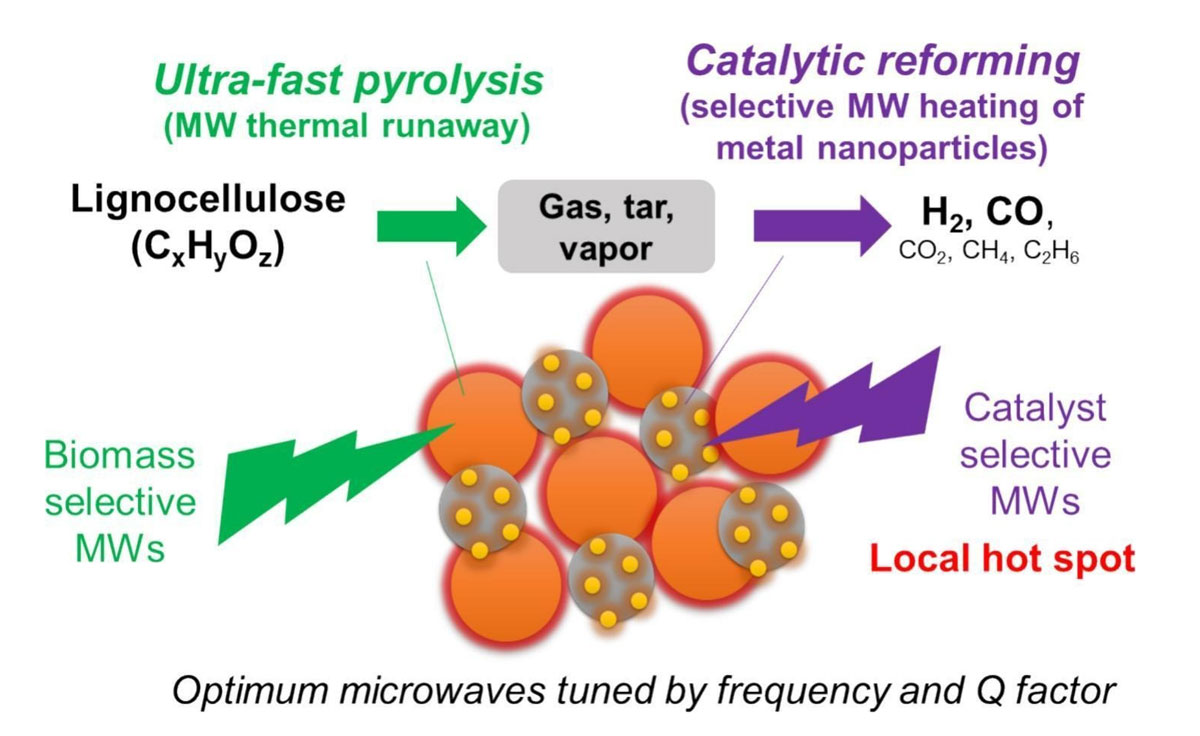
Researchers showcase how microwaves interact with the catalyst during biomass conversion, shedding light on how and why these processes could outperform conventional furnace-heated reactors.
###
For more information about this research, see “Microwave-Triggered Local High-Temperature Formation on Ni Nanoparticles that Enables Ultra-Fast Catalytic Pyrolysis of Lignocellulose,” Shuntaro Tsubaki, Jun Fukushima, Masateru Nishioka, Takeharu Sugiyama, Hisahiro Einaga, Wang-Jae Chun, Ken-ichi Kimijima, Masao Kimura, Shunsuke Ota, Noriyuki Igura, Yuji Wada, and Makoto Yasuda, Chemical Engineering Journal, https://doi.org/10.1016/j.cej.2026.179202.
Research-related inquiries
Shuntaro Tsubaki, Professor
Faculty of Engineering
Contact information can also be found in the full release.
- TOP
- News
- Research Results
- Selective microwave heating speeds bamboo-to-hydrogen fuel conversion